Annapurna Base Camp Trek Packing List
A packing list is one of the most important things for any trek, and it should be prepared beforehand.
We recommend the following packing list for the Annapurna Base Camp Trek
Clothing
- Base layers
- Trekking shorts and trousers
- Fleece or insulated jacket
- Down jacket
- Waterproof and windproof jacket
- Trekking socks
- Gloves
- Hat and beanie
- Gaiters
Footwear
- Trekking boots
- Sandals or camp shoes
- Extra socks
Backpack and Gear
- Daypack (25–35L)
- Large or duffel bag
- Sleeping bag
- Trekking poles
- Flashlight/headlamp
- Water bottles/hydration bladder
- Energy bars and snacks
Personal Items
- Sunscreen
- SPF-containing lip balm: To avoid dry lips.
- Sunglasses
- Personal toiletries
- Towel
- First aid kit
Documents and Essentials
- Passport and ID
- Permits for trekking
- Travel insurance:
- Cash
- Smartphone and camera
Optional / Extra Items
- Pen and notebook
- Book or e-reader
- Portable charger/power bank
- Binoculars
- Additional lightweight layers
Annapurna Base Camp Trek Food
Your body will require healthy, high-carbohydrate meals when travelling at high altitudes, such as the Annapurna Base Camp (4,130 metres), and when engaging in physically demanding activities like trekking.
Because of this, our 10 Days Annapurna Base Camp itinerary includes three nourishing meals a day (breakfast, lunch, and dinner). Furthermore, during the duration of the package, we will be offering you 9 breakfasts, 6 lunches and 6 dinners.
Trekkers are also reminded that, in addition to the three meals per day, there are additional costs for other food items such as tea, coffee, cold drinks, and snacks.
Breakfast
- Eggs (boiled, fried, or omelette)
- Bread, pancakes, or toast with butter or jam
- Cereal, oats, or porridge
- Hot chocolate, coffee, or tea
- Cookies, biscuits, or energy bars
- Fresh fruit in season
Lunch
- Dal Bhat Tarkari
- Pasta, chow mein, or fried rice
- Momos
- Noodle soups, also known as thukpa
- Sandwiches or parathas
- Snacks such as trail mix, chocolate, and nuts
Dinner
- Dal Bhat
- Pasta, chow mein, or vegetable fried rice
- Momos
- Tomato, chicken, or vegetable soups
- Yoghurt, pickles, or tiny salads
- Hot chocolate, coffee, or tea
Eating Advice for the Trek
- To stay hydrated, sip bottled or boiled water.
- For long trekking days, Dal Bhat is a highly recommended source of sustained energy.
- For quick energy in between meals, pack snacks like chocolates, energy bars, or nuts.
- At high altitudes, stay away from raw salads to avoid upset stomachs.
- Vegetarian or vegan diets can be accommodated at most teahouses, but make sure beforehand.
Note: Only breakfast is included during your stays in Kathmandu and Pokhara; lunch and dinner are available for an extra fee.
Accommodation During the Annapurna Base Camp Trek
You will travel to the remote and high Himalayan region on this Multi-day trekking in Nepal. This package includes accommodations in comfortable teahouses and lodges with basic amenities in the Annapurna region. Rooms for twin and triple sharing are included in the stay.
Additionally, you will have access to a three-star stay in locations like Pokhara and Kathmandu. If you want to upgrade your stays in Kathmandu and Pokhara to more luxurious accommodations, please contact us; we can make it happen for an additional fee.
Basic amenities like hot showers, Wi-Fi, charging, and hot water are available for additional fees beyond the package price. The remote location makes it difficult to find upscale amenities.
Annapurna Base Camp Trek Permits
Trekking permits are required when visiting any of the Annapurna region's trekking routes, such as the Annapurna Base Camp Trek.
Two permits are required to enter the Annapurna region. One is the Trekkers' Information Management System (TIMS) permit, which monitors the safety and whereabouts of trekkers in Nepal.
The second is the Annapurna Conservation Area Permit (ACAP), which is required to enter the Annapurna Conservation Area.
- Trekkers’ Information Management System (TIMS) Permit Cost: NPR 2000 per person.
- Annapurna Conservation Area Permit (ACAP): NPR 3000 per person.
Note: Travellers don't need to worry about permits because we arrange the necessary permits for your trip and cover all permit fees in our 10 Days ABC Trek Package.
When is the best time for Annapurna Base Camp Trek?
ABC Trekking is one of the few Himalayan treks that can be undertaken at any time of year, subject to your experience and preparation. However, autumn (September to November) and spring (March to May) are the ideal seasons for the Annapurna Base Camp Trek.
The autumn season is considered the most ideal time, with clear skies, stable weather and stunning mountain views throughout the trail. The route becomes lively during the spring season, which has moderate temperatures and blooming rhododendrons.
There are benefits and drawbacks to off-season treks in the winter (December to February) and monsoon (June to August). For travellers who prefer solitude, the winter months are ideal because they are quieter and less crowded.
However, the chilly nights and sporadic snowfall at higher elevations could be problematic. For this reason, having the right extra equipment for a winter trek will make your experience easier.
Similarly, monsoon trekking is generally not advised because of the heavy rain, slick paths, and poor visibility, but it is possible if you have the necessary skills.
Note: Since we need to make the necessary arrangements, it is best to get in touch with us before travelling during the off-season.
How do we prepare for a trek to Annapurna Base Camp?
Preparation is crucial because there are many factors to take into account before starting a long journey in the high-altitude Himalayas. Everything, from physical fitness to endurance, gear, and permits, must be double-checked.
Before travelling to Annapurna, the following steps must be completed
- Physical Fitness: Six to eight weeks prior to the trek, increase your endurance by hiking, stair climbing, and cardio exercises.
- Strength Training: To manage long ascents and carry a daypack, concentrate on your back, legs, and core muscles.
- Acclimatisation Knowledge: Acquire knowledge of the signs of altitude sickness and methods for a gradual adjustment.
- Gear Preparation: Gather suitable trekking boots, warm clothing, a sleeping bag, a daypack, and trekking poles.
- Packing List: Include a first-aid kit, water bottles, sunscreen, snacks, and personal documents.
- Mental Preparation: Prepare yourself for long days, shifting weather, and everyday life in a teahouse.
- Training Hikes: Take a few hikes at a moderate altitude while carrying a heavy backpack.
- Travel & Permits: Verify travel insurance, TIMS and ACAP permits, and flights or road transportation.
- Hydration & Nutrition: During training hikes, begin practising energy snacks and hydration techniques.
Major Attractions of the Annapurna Base Camp Trek
The Annapurna Base Camp Trek offers a variety of highlights, breathtaking views of the Himalayas, lively Gurung villages, and steaming hot springs.
Annapurna Base Camp (4,130 m)
- With a close-up 360-degree view of giants like Annapurna I, Annapurna South, Hiunchuli, Machhapuchhre, and more, this is the trek's highest point. One of the most amazing sights in the Himalayas is the sunrise view at the base camp.
Jhinu Danda Natural Hot Springs
- The natural hot pools at Jhinu Danda, which are close to the Modi Khola, are ideal for unwinding after long trekking days.
- It is a well-liked location to relieve tense muscles and take in the tranquil riverbank setting.
Stunning Mountain Views
- You are fortunate to have continuous views of Fishtail (Maachhapuchhre), Annapurna South, Hiunchuli, Gangapurna, and Tent Peak along the trek route.
- The main highlights of the mountain views, particularly from the ABC, are the golden hour and the sunrise views.
Rich Flora and Fauna
- Lush rhododendron forests, bamboo groves, alpine vegetation, and high-altitude landscapes are all part of the route to ABC.
- If you're lucky, you might also see a variety of birds, pheasants, langur monkeys, and Himalayan thar.
Gurung Culture & Villages
- The Gurung culture and villages are another significant highlight of this ABC trek. In locations like Ghandruk and Chhomrong, you can visit the traditional Gurung communities.
- Additionally, discover the way of life, friendly hospitality, stone-paved villages, and culture influenced by Buddhism.
Pokhara – The Lakeside City
- A significant highlight of this trip is Pokhara, the starting point for the ABC trek and well-known for its serene Phewa Lake, exciting nightlife, and adventure activities.
- Before and after the hike, Pokhara is a great spot to decompress.
Annapurna Base Camp Trek Elevation
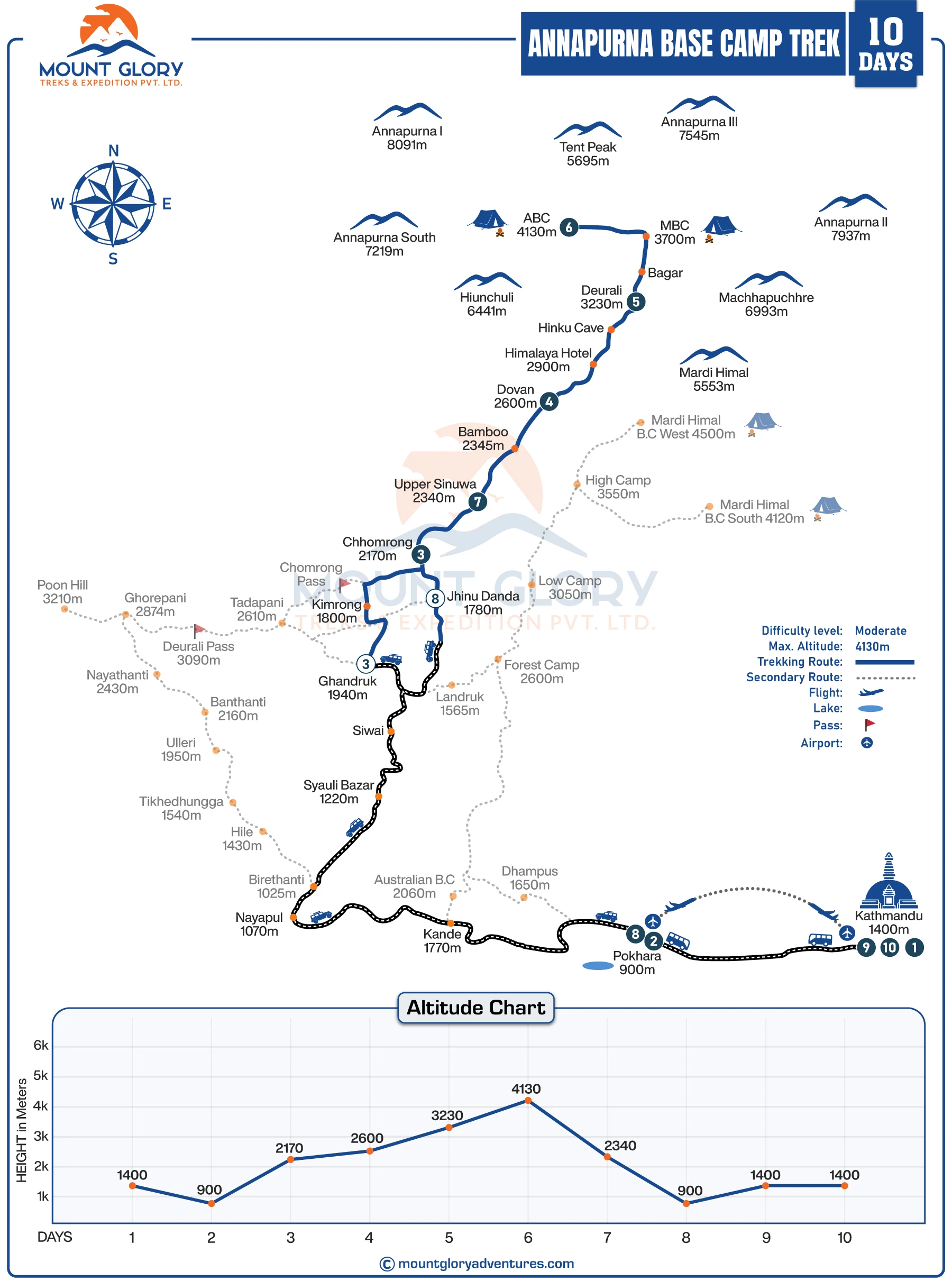
Annapurna Base Camp, located at 4,130 metres (13,549 feet), is surrounded by towering peaks such as Annapurna I, Hiunchuli, and Machhapuchhre.
From low hills to high alpine zones, this trek offers hikers a gradual acclimatisation experience due to its wide range of altitudes.
Additionally, there are picturesque stops along the way in the mid-altitude villages and forested areas, which are located between 1,900 and 3,000 metres. On the other hand, rocky trails, moraines, and high-altitude meadows can be found in the alpine zones above 3,500 metres.
In order to avoid altitude sickness close to the destination, appropriate pacing, hydration, and rest are crucial for the ABC Trek.
The detailed altitude of the Trek to Annapurna Base Camp is displayed in the table below.
| Trek Section | Elevation in metres | Elevation in feet |
| Kathmandu | 1324 | 4,344 |
| Pokhara | 820 | 2690 |
| Ghandruk | 1940 | 6365 |
| Chhomrong | 2170 | 7119 |
| Dovan | 2600 | 8530 |
| Deurali | 3230 | 10597 |
| Machhapuchre Base Camp | 3700 | 12139 |
| Annapurna Base Camp | 4130 | 13549 |
| Upper Sinwa/Bamboo | 2,310 / 2,500 | 7,579 / 8,202 |
| Jhinu Danda | 1780 | 5840 |
How hard is the Annapurna Base Camp Trek in Nepal?
The standard ABC Trek in Nepal is considered a moderate trek, appropriate for beginners with good basic fitness. Additionally, the trek's highest point is 4,130 metres, making the altitude noticeable but doable at a steady pace.
During this ten-day journey to ABC, you will typically walk for five to seven hours every day, which calls for endurance and perseverance.
Long, steep stone steps can be found along many parts of the trail route, particularly in the vicinity of Chhomrong and Sinuwa. Speaking of weather, it can change rapidly in the Annapurna Sanctuary, making mornings and overcast afternoons more difficult.
The trails are well-maintained and marked, which lowers technical difficulty and facilitates navigation for novice hikers.
The ABC trek is comfortable and achievable with the right planning, a slow pace, and some basic trekking knowledge and experience.
Guide and Porter Service
For the trek to Annapurna Base Camp, a guide is required. Mount Glory Treks provides one experienced guide for a group of eight. If there are more than eight people in your group, we will provide an additional assistant guide to make your trip easier.
Porters are crucial to your mountain journey because they are in charge of transporting your heavy bags and luggage. Since trekking in Nepal's challenging Annapurna region is nearly impossible without porters, we include them in our package. A porter can carry up to 25 kg of luggage for two travellers.
Note: Our packages include lodging, food, transportation, and travel insurance for our guides and porters.
Altitude Sickness: How to avoid it?
Inadequate adaptation to high altitude can lead to acute mountain sickness, also known as altitude sickness.
Symptoms of altitude sickness include
- Headache
- Dizziness/light-headedness
- Nausea or loss of appetite
- Fatigue or difficulty sleeping
- Shortness of breath while resting
Trekking at high elevations, like the Annapurna Base Camp (4,130 m) in the Annapurna region, greatly increases the risk of altitude sickness.
For your brief Trek to Annapurna Base Camp, our experienced trekking guides and trip planners have offered the following advice to lower the risk of altitude sickness.
- It is advised to hike to higher elevations and sleep at lower elevations.
- Drink three to four litres of water every day and stay away from alcohol and caffeine to stay hydrated.
- To strengthen the body and immune system, eat foods high in carbohydrates, such as rice, noodles, and dal bhat.
- You should always take your time and not rush, even if you feel strong at the start of your journey.
- To prevent the illness, discuss acetazolamide (Diamox) with your physician.
- You should not ignore symptoms like headaches, nausea, and dizziness; if they get worse, go downstairs or take a nap.
- When it's cold outside, stay warm, avoid overdoing it, and get enough sleep.
- Observe your Guides and seek assistance if you encounter any difficulties.
Is Annapurna Base Camp Trek Safe?
Compared to other high-altitude treks in Nepal, the Annapurna Base Camp Trek is thought to be extremely safe. Teahouses at significant stops support the well-established, regularly used route to the ABC.
There are plenty of hikers, guides, and locals on the trail during the busiest times of year, which improves both the overall experience and safety.
The risk of altitude sickness is minimal to manageable due to the trek's moderate altitude and appropriate pace. Additionally, if necessary, emergency helicopter evacuation is accessible throughout the area.
There are no dangerous cliffs or difficult climbing on most of the trail, which is non-technical. Additionally, the locals and owners of teahouses are friendly and used to helping hikers.
Organising your trip with a certified tour guide or a respectable company like Mount Glory Treks significantly improves security and lowers overall risks.
Is travel insurance required for the Annapurna Base Camp Trek Nepal?
It is advised that you have the proper travel insurance before beginning your Annapurna Base Camp Trek with us.
Additionally, you should purchase high-altitude travel insurance from a reliable travel company and make sure that it covers trekking risks such as helicopter evacuation, medical coverage, and any kind of emergency at elevations of 4000 m and above.
Travel insurance protects you against risks like altitude sickness, injuries, sudden illness, and trip cancellations, which can be very costly in isolated parts of the Himalayas in Nepal.
Things You Should Know
Before your ABC trek, there are a few other things you should know about the Annapurna region in addition to the trekking route, preparations, and cost.
These items are not part of the package and will add to your ABC Trek budget.
Drinking Water
- All teahouses have boiled drinking water, though it may become harder to find at higher elevations. Depending on the location, boiled drinking water typically costs between NPR 100 and NPR 300 per litre.
- While bottled water can cost anywhere from NPR 80 to NPR 300 per bottle, you can save money and cut down on plastic waste by using purification tablets or filters.
Hot Showers
- For an additional fee, the majority of teahouses along the ABC route offer hot bucket or gas/solar showers. Each shower costs between NPR 200 and NPR 500, and the price goes up as you ascend.
Charging Electronics
- Electricity is available in the Annapurna region's high-altitude areas. Depending on the device, charging a phone, camera, or other electronic device will cost you between NPR 200 and NPR 600. Never forget that the cost increases with altitude.
Wi-Fi Availability
- The majority of stays at ABC Trek have wifi, which is primarily run by local networks. Additionally, a single wifi login card typically costs between NPR 200 and 500, and in higher regions, the speed may be inconsistent.
ATM Access
- You should be aware that there are currently no ATMs on the trek. Pokhara has the last trustworthy ATMs. A minimum of NPR 15,000 to NPR 25,000 should be carried for meals, showers, charging, and minor expenses while travelling.
Money Exchange
- Money exchange services are available in both Kathmandu and Pokhara, but Kathmandu offers the best rates, and Pokhara has a slightly higher spread. Once you enter the trekking area, there are no exchange facilities. Before departing Pokhara, it's advisable to exchange enough Nepali rupees.
Is ABC Trek perfect for beginners?
The Annapurna Base Camp Trek in Nepal is regarded as a beginner-friendly trek that anyone without any prior experience can undertake.
Beginners may not have many issues because the trails are well-established, the altitude is moderate when compared to other difficult high Himalayan treks, and the teahouse amenities are comfortable.
However, you must ensure that you are reasonably fit and ready for the ABC journey. Beginners should consider the following before travelling.
- There are lengthy walking days with lots of ascents and stone steps.
- The trek reaches its highest point at 4,130 metres, so proper pacing and acclimatisation are critical.
- Pre-trek training or some basic trekking experience makes the trip much simpler.
Where is Annapurna Base Camp, and who discovered it?
The Annapurna Base Camp (ABC) is situated inside the Annapurna Conservation Area (ACA) of Kaski District in the Annapurna region of north central Nepal.
ABC is located within the Annapurna Sanctuary, a natural amphitheatre of peaks, at an elevation of 4,130 metres (13,550 feet).
Annapurna I, Annapurna South, Hiunchuli, Machhapuchhre (fishtail), and a number of other Himalayan peaks are among the nearby mountains.
During the 20th century, explorers and surveyors first recorded and mapped the Annapurna Himal, particularly during Himalayan reconnaissance missions. Additionally, Annapurna I was the first 8,000-meter peak ever reached when a French expedition led by Maurice Herzog and Louis Lachenal climbed it for the first time in 1950.
Although no one person is credited with finding the ABC, the route and area gained widespread recognition following the 1950 French expedition that explored the Annapurna Sanctuary and recorded its topography.
Since then, one of Nepal's most well-liked trekking routes has emerged from the Annapurna region, particularly the ABC.
How to get a visa for Nepal?
A tourist visa is required for foreign visitors to Nepal who are there for a trek, tour, or other adventure. But compared to other countries, getting your tourist visa is easier in Nepal.
The majority of foreign visitors can obtain a visa at Kathmandu's Tribhuvan International Airport, and you can complete the online application form to expedite the process.
You must fill out the visa application form and have a passport that is valid for at least six months before you can apply for a visa upon arrival.
The costs to get a Nepali visa are as follows:
- 15‑day visa: US $30
- 30‑day visa: US $50
- 90‑day visa: US $125
Tipping Culture
Tipping is an excellent way to thank your guides and porters for their assistance during your Annapurna Base Camp Trek Via Kathmandu, though it is not required. Tipping should typically be at least 10% of the trip's total cost.
If you were extremely pleased with the service, you may tip more than the minimum required for the trip.
Farewell Dinner
We will arrange a farewell dinner for you when you successfully complete your trek to ABC and return to Kathmandu from Pokhara. This will be a unique opportunity to commemorate your accomplishment, talk about your experiences, and take stock of the amazing journey.
You will also have the chance to comment on our services, guides, and general assistance during your journey during the dinner. It's how we thank you for selecting us and make sure your journey ends on a special note.
This farewell dinner also honours your journey, your tenacity, and the relationships you formed along the way.
Trip Completion Certificate
As a reward for your accomplishment, you will receive an official trip completion certificate during our final meeting in Kathmandu prior to the final departure.
The certificate is a significant acknowledgement of your hard work, determination, and accomplishment in reaching one of Nepal's most famous Himalayan destinations.
Additionally, the trip completion certificate can be framed and treasured as a part of your travel achievements, or it can be proudly shared with friends and family.
What is the difference between the Annapurna Base Camp Trek and the Annapurna Circuit Trek?
While both the Annapurna Base Camp Trek and the Annapurna Circuit Trek are trekking routes in the Annapurna region, they differ greatly from one another.
The table below shows the detailed difference
| Features | Annapurna Base Camp Trek | Annapurna Circuit Trek |
| Route Type | A direct trek into the Annapurna Sanctuary (base camp experience) | A full circuit around the Annapurna massif |
| Trek Duration | Around 7–10 days | Around 12–18 days |
| Maximum Altitude | 4,130m (Annapurna Base Camp) | 5,416m (Thorong La Pass) |
| Difficulty Level | Moderate, beginner-friendly Himalayan trek | Challenging, suitable for experienced trekkers |
| Main Highlights | Close-up views of Annapurna I, Machhapuchhre (Fishtail), Hiunchuli | Diverse landscapes, high passes, Mustang-like desert terrain |
| Scenery | Lush forests, terraced fields, Gurung villages, mountain amphitheatre | Subtropical valleys, alpine zones, arid trans-Himalayan landscapes |
| Cultural Experience | Gurung and Magar villages with traditional Himalayan lifestyle | Wide ethnic diversity across multiple regions |
| Weather & Conditions | More stable and accessible year-round (seasonal preference still applies) | More varied and affected by high-altitude pass conditions |
| Physical Demand | Moderate trekking with steady ascent | High endurance required due to long duration and high pass crossing |
| Best For | First-time trekkers, families, and moderate adventure seekers | Experienced trekkers seeking altitude challenge and long expeditions |
How to Book the Annapurna Base Camp Trek 10 Days?
Are you excited to finish the 10-day trek to Annapurna Base Camp? Making bookings for this once-in-a-lifetime opportunity is much easier than you might imagine.
Our booking and payment systems are easy to use, secure, and safe for your convenience.
You can book this trip by clicking the Reserve Now button on our website. We can also be reached directly through WhatsApp, WeChat, or email.
After making your reservation, it is recommended that you email us your flight details, a copy of your passport, and your travel insurance so that we can appropriately arrange your trip.
For pre booking any trip with us travelers need to pay 20% amount as a advanced and the rest amount will pay upon arrival in Kathmandu in our pre trek meeting season pay with cash,Card or Bank transfer.
How to extend your stay in Nepal after the ABC Trek?
Once you've finished the Annapurna Base Camp Trek, you'll want to see more of Nepal. After that, you can decide to prolong your trip to Nepal in order to experience its diverse wildlife, rich culture, and breathtaking scenery.
To maximise your time, you can choose from a number of custom packages offered by Mount Glory Treks after the ABC package.
Chitwan National Park – 3 Days / 2 Nights
- Discover Chitwan's wildlife safaris, which feature elephants, rhinoceroses, Bengal tigers, and more than 450 bird species. Jeep safaris, canoe rides, nature walks, and visits to traditional Tharu villages are among the activities.
- Our team arranges lodging options ranging from eco-lodges to luxury resorts; for more information, see our Chitwan Tour Packages.
Pokhara Sightseeing – 1 Day
- You can add a quick stay in Pokhara, which includes a day of sightseeing, after finishing your trek. Discover the World Peace Pagoda, Devi's Fall, Gupteshwor Cave, and the tranquil Phewa Lake.
- In the laid-back atmosphere of Pokhara, you can also enjoy boating, paragliding, ultralight flying or cafes by the lake.
Kathmandu Sightseeing Tour – 1 Day
- Explore Kathmandu's UNESCO World Heritage Sites, such as Bhaktapur, Patan Durbar Square, Boudhanath Stupa, and Pashupatinath Temple.
- Our knowledgeable staff will arrange for comfortable transportation, local guides and admission tickets to ensure you don't miss any of the highlights.
Additional Trekking Options
- Additionally, if you are an adventure seeker and want to experience more of the Himalayan journey, you can take advantage of packages such as:
- The longer and more difficult Annapurna Circuit Trek circumnavigates the Annapurna Mountains and covers all of the region's highlights.
- Similarly, the Langtang Trek is a stunning walk that circles the Langtang Valley, which is renowned for its picturesque scenery and Tamang culture.

 based on 218 reviews


.webp)
.webp)
.webp)
.webp)
.webp)
.webp)
.webp)
.webp)
.webp)
.webp)
.webp)
.webp)
.webp)