How hard is the 14 Days Everest Base Camp Trek in Nepal?
The Everest Base Camp Excursion in Nepal is regarded as moderate to challenging, primarily because of the altitude rather than the technical difficulty.
Additionally, the 14 days trek to EBC is not too difficult for fit hikers with sufficient mental stamina.
Here are some reasons why the Everest journey is considered not too hard:
- Requires 5-7 hours of walking per day over 14 days, with some days that are longer and more demanding.
- It reaches a maximum altitude of 5,364 m at EBC and 5,644 m at Kala Patthar, making altitude adaptation necessary.
- Stone steps, rocky paths, and suspension bridges make up the well-marked, non-technical trails.
- Includes scheduled days for acclimatisation at Dingboche and Namche Bazaar, which lessens the difficulty of the trek.
- Requires a high level of physical fitness, particularly endurance for long trekking days and uphill walks.
- The difficulty increases as the temperature and weather above Lobuche get colder and windier.
- Higher altitude basic teahouse facilities demand mental toughness and flexibility.
- Using a porter makes the journey easier; carrying a heavy backpack can make it much more difficult.
It is appropriate for fit beginners who prepare ahead of time, pace themselves appropriately, and follow safety guidelines.
Packing list for 14 Days Nepal Everest Base Camp Hike
A packing list is one of the most important items for any trek and should be organised before departure. Likewise, we recommend the following packing list for the Everest Base Camp 14-Day Trip.
Clothing
- Base layers: moisture-wicking t-shirts and warm thermal tops.
- Trekking trousers and shorts: Lightweight, comfortable and dry quickly.
- Fleece or insulated jacket: Offers warmth on cold mornings and evenings.
- Down jacket: A must-have for high-altitude evenings around EBC.
- Waterproof and windproof jacket: Protects against rain and wind.
- Trekking socks: Several pairs of wool or synthetic.
- Gloves: Insulated gloves for higher altitudes and light trekking gloves.
- Hat and beanie: Warm beanie in the evening, sun hat during the day.
- Gaiters: Optional for muddy or snowy conditions.
Footwear
- Trekking boots: supportive of the ankle, waterproof, and well-made.
- Sandals or camp shoes: For relaxing in lodges.
- Additional socks: For daily changes and to keep feet dry.
Backpack and Gear
- Daypack (25–35L): For daily essentials, layers, water, snacks, and a camera.
- Big or duffel bag: If using porter services, for porter transportation.
- Sleeping bag: Suitable for -10°C to -15°C High Altitude nights.
- Trekking poles: Optional, but useful on steep and uneven terrain.
- Flashlight/headlamp: With additional batteries.
- Water bottles/hydration bladder: 2–3 litres capacity.
- Energy bars and snacks: For quick energy while hiking.
Personal Items
- Sunscreen: SPF 50+ for protection from the sun at high altitudes.
- SPF-containing lip balm: To avoid dry lips.
- Sunglasses: UV-blocking, preferably wraparound.
- Personal toiletries: toothbrush, toothpaste, biodegradable soap, hand sanitiser, and wet wipes.
- Towel: Quick-drying travel towel.
- First aid kit: Include bandages, blister pads, painkillers, altitude sickness tablets, and any personal medications.
Documents and Essentials
- Passport and ID: Required for permits and accommodation.
- Permits for trekking: Sagarmatha National Park Permit and Khumbu Pasang Lhamu Permit.
- Travel insurance: Helicopter evacuation and high-altitude trekking must be covered.
- Cash: Nepali Rupees for lodging, small purchases, and snacks.
- Smartphone and camera: For navigation and taking pictures.
Optional / Extra Items
- Pen and notebook: For keeping a journal.
- Book or e-reader: For entertainment during downtime.
- Portable charger/power bank: Solar chargers are useful in remote locations.
- Binoculars: Use them to see distant peaks and spot wildlife.
- Additional lightweight layers: To increase layering flexibility.
Note: Mount Glory Treks will provide a 60 Ltr Duffel Bag for trekking use. We will provide this during our first meeting in Kathmandu before going on the trek. Also, we will provide an EBC Trek Route Map, a Company T Shirt and a Sleeping Bag for trekking use.
Is this 14 Days EBC Trek in Nepal ideal for me?
Travellers' interests in trekking destinations vary. While some prefer leisurely treks with less demanding days, others enjoy challenging high-altitude hiking.
However, not everyone is suited for this 14 days Everest base camp journey, which is a true Himalayan adventure trek. Let's examine the following details to determine if the trek package is the best choice for you:
- Ideal for those looking for a traditional Everest Region experience that includes enough acclimatisation days for a safe altitude adjustment.
- The journey is best for trekkers who are fit and capable of walking 5-7 hours per day on varied terrain.
- If you're looking for a balanced mountain trek itinerary that minimises risks and avoids rush, this trek is highly recommended.
- As long as you are physically prepared beforehand, this trip is also appropriate for first-time high-altitude hikers.
- This Nepal trekking route to Everest journey is ideal if you want to see iconic locations and mountain scenery and immerse yourself in local culture.
- A good fit if you prefer authentic Himalayan experiences and teahouse-style accommodations over luxury comforts.
- Particularly best for those who want a tried-and-true, professionally run trekking plan and are travelling in 2026.
- Suitable for small groups, couples, and solo trekkers seeking guided assistance from knowledgeable Himalayan specialists.
- If you have serious heart, knee, or altitude-related issues without a doctor's approval, it is not advised to go on this trip.
- This Everest journey is a must-do adventure for you if you want to stand at the foothills of Mount Everest and watch the magical sunrise from Kala Patthar.
How do we prepare for a 14 Days trek to EBC in Nepal?
Preparation is crucial because there are many factors to take into account before starting the 14 trek in the high-altitude Himalayas of the Everest region. Everything needs to be verified twice, including equipment, permits, endurance, and physical fitness.
Before travelling to the Everest Base Camp, the following preparations are suggested:
- Regular cardio exercises like walking, stair climbing, jogging, or cycling should be started at least six to eight weeks in advance.
- In particular, practise walking uphill and descending while concentrating on leg strength and endurance.
- To become accustomed to trekking conditions, take long walks with a rucksack.
- Improve your general flexibility and fitness to prevent injuries and exhaustion on long hiking days.
- Make sure your travel insurance covers both emergency evacuation and high-altitude hiking.
- Purchase high-quality trekking boots and wear them well in advance of the trip.
- Prepare appropriate layered attire for chilly nights, windy afternoons, and chilly mornings.
- Discover the signs and symptoms of altitude sickness as well as appropriate acclimatisation methods.
- Instead of rushing the itinerary, plan for a slow and steady pace.
- Prior to the journey, get a basic medical examination, particularly if you have any health issues.
- Bring enough cash for emergencies, food, and amenities because high-altitude trekking routes lack ATMs.
- During the hike, pay attention to what your guide says, stay hydrated, and eat healthily.
Best time for the Everest Base Camp Trek in Nepal
The seasons have a significant impact because the Himalayan adventure differs from regular hiking. Even though the trek is technically feasible most of the year, the experiences, vibes, and views may vary depending on the time of year.
Spring (March to May)
For the 14 days Everest Base Camp Trek in Nepal, spring is one of the most popular seasons because it offers consistent weather, clear skies, and good mountain visibility.
Even though the nights are still chilly, the daytime temperatures are suitable for hiking.
The rhododendron forests that bloom at lower elevations, adding colour to the trail, are the best part of the trip in the spring.
Additionally, because it is the height of spring, there may be more people on the route in the months of April and early May.
Summer / Monsoon (June to August)
Due to frequent rainfall at lower elevations, which makes the trails wet and slick, the monsoon/summer season, which runs from June to August, is the least crowded time of year for trekking to EBC.
The primary issue during the monsoon season is that clouds obscure views of the mountains, particularly in the afternoon. However, the trail is replete with verdant scenery and new vegetation.
Additionally, there is a greater likelihood of weather-related flight delays to Lukla.
Autumn (September to November)
The autumn season, which runs from September to November, is thought to be the best time for the trek to Everest Base Camp. This month offers the best, with clear skies, clean air, and breathtaking views of the Himalayas.
At higher altitudes, you can experience both the comforts and the chills because the daytime temperatures are mild and the nights are chilly.
Additionally, the peak trekking months of October and early November can be extremely busy, and the trail conditions are well-established following the monsoon.
Winter (December to February)
There are fewer hikers during the winter season, which runs from December to February and is the coldest on the EBC route. However, this provides a more tranquil and quiet experience, which can be perfect for such loving.
The higher passes and trails above Dingboche may have been blocked by the snow, so familiarise yourself with the route.
On calm days, winter offers you breathtaking views and pristine skies. The winter hike to EBC is appropriate for hikers who can withstand extremely cold temperatures and are well-prepared.
Where is Everest Base Camp located, and who discovered it?
The most famous base camp in the world, Everest Base Camp (EBC), is situated in Nepal's Khumbu region, which is part of the country's Solukhumbu district.
Furthermore, the base camp is located within the Sagarmatha National Park and falls under the governance of the Khumbu Pasang Lhamu rural municipality.
At the base of the Khumbu icefall, the Everest Base Camp Elevation is 5,364 metres (17,598 feet).
The Khumbu region is well-known worldwide for its Sherpa culture and high Himalayan scenery, and climbers aiming to reach the summit of Mount Everest start their journey at base camp.
Local sherpa communities have been using the area for centuries, long before modern expeditions began.
In the early 1920s, British mountaineers led the first organised expeditions to set up an Everest base camp, including the 1921 and 1922 expeditions. Furthermore, one of the most well-known climbers to use the early EBC route was George Mallory and his group.
The EBC became well-known throughout the world following the first successful ascent of Mount Everest in 1953 by Sir Edmund Hillary and Tenzing Norgay.
That was history, and the Everest Base Camp is still a popular trekking destination today, drawing visitors from all over the world. Giving hikers a close-up view of the highest mountain in the world, EBC, continues to be a top priority for the majority of travellers.
Are Beginners Suitable for the 14 Days Everest Base Camp Trekking in Nepal?
Beginners who are eager, committed, and ready for a high-altitude experience are frequently thought to be able to complete the Everest Base Camp Trek. Every year, a lot of first-time hikers successfully finish it, despite the fact that it is more difficult than moderate treks.
Because the trails are clearly marked, and it's a Tea house trek, and the itinerary includes necessary acclimatisation days, beginners may find the route manageable. However, patience and appropriate fitness are essential because the trek reaches much higher elevations than most beginner treks.
If they plan ahead and take a cautious approach, beginners can still experience the thrill of reaching Everest Base Camp and getting up close and personal with the Himalayas.
Beginners should consider the following before embarking on the EBC adventure:
- Walking distances on a daily basis can be lengthy and frequently involve an uneasy, careful pace and acclimatisation time.
- The physical difficulty is increased by cold temperatures and shifting weather.
- The trek is much more comfortable if you have some light training or basic physical conditioning before you leave.
- To enjoy the trip safely, you must have an optimistic outlook and be willing to change your pace.
How safe is the hike to the Everest Region in Nepal?
You can be certain that trekking to the world's most well-known trekking destinations is safe. When hikers adhere to the appropriate accommodations and guidelines, the EBC trek is deemed safe.
The Khumbu region trail is well-travelled, well-marked, and supported by teahouses all along the way. There are more hikers, guides, and local employees on the route during the busiest trekking seasons, which improves overall safety.
Although altitude sickness is still a possibility, it can be controlled with the right pace and assistance from knowledgeable Sherpa guides. Additionally, the 14 days Everest Base Camp itinerary includes days set aside for acclimatisation, which lowers the possibility of altitude-related issues.
The availability of emergency helicopter evacuation throughout the Khumbu region, even at high altitudes, gives you peace of mind knowing that a helicopter will save you in any emergency.
When travelling with a travel agency, their Nepal trekking guide keeps an eye on their health, gives safety instructions, and makes sure the hikers keep a safe pace. For this reason, selecting a reliable trekking company or a certified guide greatly increases safety and lowers risks.
Everest Base Camp Altitude
Situated beneath the world's tallest mountain, at 5,364 metres (17,598 feet), the Everest base camp is located in the centre of the Khumbu region.
From the verdant valleys of Lukla and Phakding (2,600-2,800m) to the high, desolate landscapes above 5,000m, this 14 days Everest trek itinerary takes you across a vast altitude range.
The Himalayan adventure travel route offers hikers a gradual and steady acclimatisation profile as it passes through Sherpa villages, forests, suspension bridges, monasteries, glacial valleys, and rough alpine terrain.
Because of the well-timed acclimatisation days, the Everest region trails mid-altitude sections, like Namche, Tengboche, and Dingboche, which allow the body to gradually adapt.
In order to prevent altitude sickness, adequate hydration, pacing, and rest days are crucial because the terrain becomes rocky, windy, and sparse above 4,500 metres of the Everest Base Camp.
The standard EBC Trek 14 days itinerary is thought to be the safest option for novice and intermediate hikers because of the steady but substantial altitude gain.
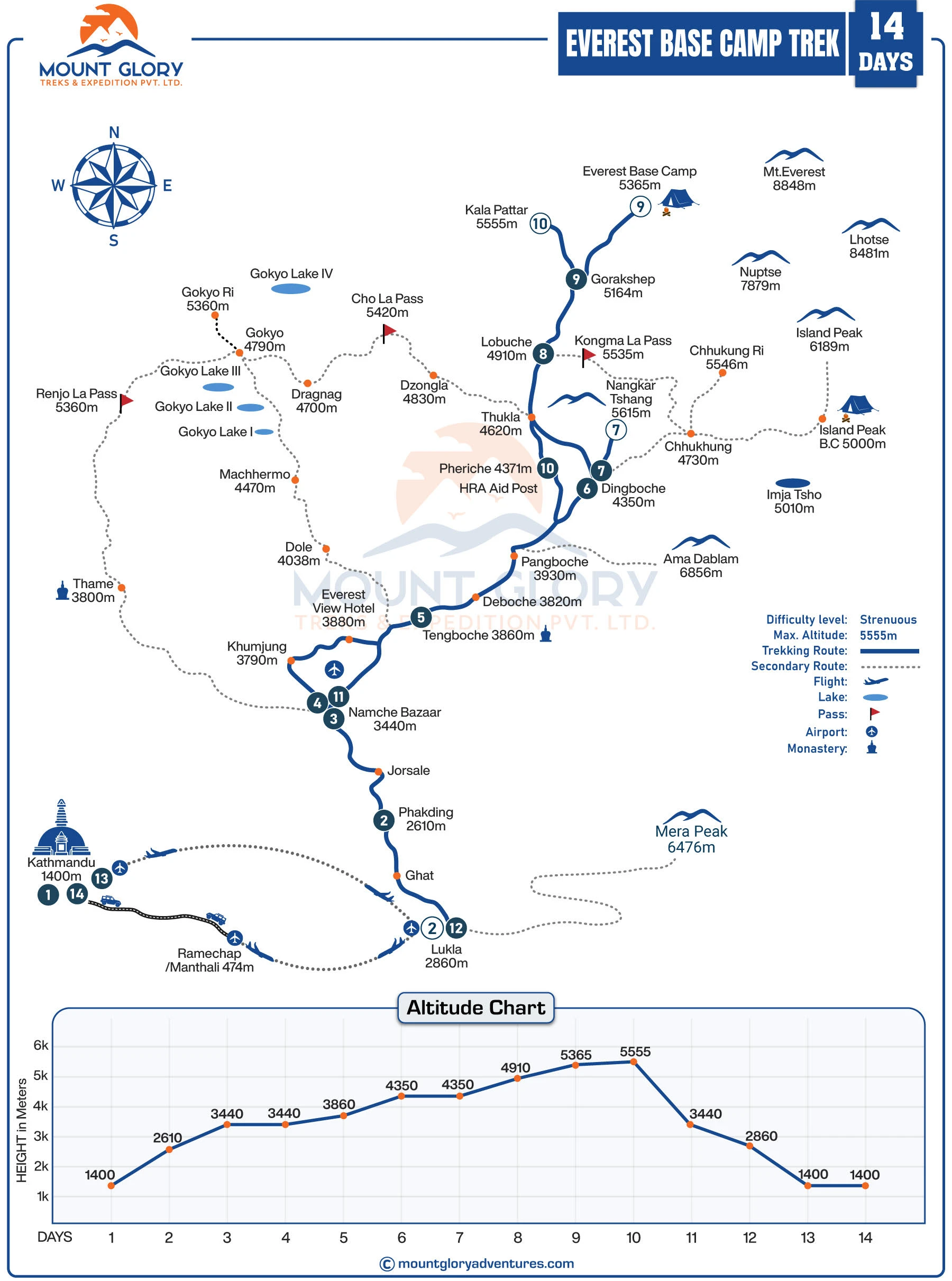
The table below shows the precise altitude of the trek section of the route to EBC:
| Trekking Route | Distance | Duration | Altitude in meters |
| Lukla to Phakding | 6km | 3-4 hours hike | 2610m |
| Phakding to Namche Bazar | 10km | 5-6 hours hike | 3440m |
| Namche to Tengboche | 9 km | 5-6 hours hike | 3810m |
| Tengboche to Dingboche | 9km | 5-6 hours hike | 4440m |
| Dingboche to Lobuche | 8km | 4-5 hours hike | 4910m |
| Lobuche to Gorekshep | 4km | 2-3 hours | 5140m |
| Gorekshep to Everest Base Camp | 3.5km | 2-3 hours hike | 5364m |
| Gorekshep to Kala Patthar | 2 km | 1.3 - 2 hours hike | 5555m |
| Gorekshep to Pheriche | 11 km | 6-hour hike | 4280m |
| Pheriche to Namche Bazar | 16km | 6-7 hours hike | 3440m |
| Namche Bazar to Lukla | 14km | 6-7 hours hike | 2610m |
14 Days Everest Base Camp Trek Permit
Before you start your journey in the Everest region, you must obtain two permits. Trekkers must obtain permits for Sagarmatha National Park and Khumbu Pasang Lhamu Rural Area.
Since the Khumbu region is a local government-protected area, the Khumbu Pasan Lhamu Rural Area permit is necessary to enable the municipality to oversee trekking operations. Additionally, the fee funds bridge repairs, trail maintenance, and the upkeep of walking routes that are utilised by all hikers.
Similarly, the Everest region is located within Sagarmatha National Park, a UNESCO World Heritage Site, and entry is subject to an environmental conservation fee. This permit assists the government in funding trail safety, wildlife protection, and the maintenance of the park's delicate alpine ecosystem.
The fees for the permits are as follows:
- Sagarmatha National Park Permit: 3000 NPR
- Khumbu Pasang Lhamu Permit: 3000 NPR
Note: All permits are included in our Everest Base Camp trek package, so hikers don't need to worry about them.
Food During 14 Days Everest Base Camp Trek
When travelling at high altitudes, like the Everest Base Camp, or participating in physically demanding activities, like trekking, your body will need nutritious, high-carbohydrate meals.
As a result, our 14 days itinerary for the Everest trek includes three nutritious meals per day: breakfast, lunch, and dinner.
You can select from the menu, but be aware that there may not be as many options as you would like because of the remote location.
Breakfast Options
- Porridge (plain, honey, apple, cinnamon)
- Tibetan bread with eggs or jam
- Pancakes (apple, chocolate, honey)
- Omelette or scrambled eggs
- Muesli / Cornflakes with hot milk
- Toast with peanut butter/honey
- Chapati with curry or eggs
- Tea, coffee, hot lemon, ginger tea
Lunch Options
- Dal Bhat (rice, lentils, vegetables, pickle, sometimes curry)
- Fried rice (veg/egg)
- Veg noodle soup / Thukpa
- Veg chow mein
- Spaghetti or macaroni
- Potato dishes (fried potatoes, boiled potatoes, potato curry)
- Sherpa stew
- Roti with veg curry
- Soups (garlic, veg, noodle soup)
Dinner Options
- Dal Bhat
- Veg pasta or macaroni
- Veg fried noodles
- Veg pizza (in Namche, Dingboche, Lukla)
- Soups (lentil, garlic, mixed veg)
- Thukpa / Sherpa stew
- Mashed potatoes or potato curry
Note: Trekkers are also reminded that there are extra fees for other food items like tea, coffee, cold drinks, and snacks in addition to the three meals per day.
Accommodation during EBC Trek 14 Days
The accommodations for this 14-day Everest Base Camp Trek are traditional Sherpa teahouses spread across the Khumbu region. For trekking at high altitudes, these teahouses provide simple yet cosy amenities.
Lodge Type: Simple rooms with wooden beds, mattresses, pillows, and blankets are offered by local Sherpa family-run teahouses. As you rise above Namche and Tengboche, the facilities become less sophisticated.
Room Layout: In lower altitudes, there are a few single rooms, but the majority of rooms are twin-sharing. During the busiest times of the year, single rooms are rarely available at higher elevations like Lobuche and Gorakshep.
Heating: Although dining halls typically have a central yak-dung stove (bukhari) where hikers congregate every evening for warmth, bedrooms are not heated.
Bathroom Type: While higher-altitude teahouses typically have shared Western or squat-style restrooms, lower regions may have attached bathrooms.
Hot showers: In lower regions, hot showers are available for an additional fee. Solar-powered bucket-style hot showers are prevalent above Tengboche.
Charging Facilities: For an extra charge, electronics can be charged in the dining area. Because there are fewer energy sources at higher altitudes, costs increase.
Wi-Fi and Network: Although the speed is slow, most villages have access to EverestLink or local paid Wi-Fi. Up to Tengboche, mobile networks function, but they drastically deteriorate above that.
Bedding and Blankets: Teahouses offer simple blankets, but for colder regions like Dingboche, Lobuche, and Gorakshep, a sleeping bag that is between -10°C and -20°C is highly advised.
Availability: Teahouses fill up fast during the busiest trekking seasons, which are March–April and October–November. Better room options are guaranteed if you arrive early.
High-altitude Conditions: Because of the severe weather, scarce resources, and challenging supply routes, higher villages like Lobuche and Gorakshep have very basic rooms.
Note: Due to the 14 Day EBC Trek being an affordable trek package, you are only provided with basic facilities. And if you are willing to upgrade your accommodation to more luxurious stays, then you can contact us to plan your trek accordingly. Or you can also choose from our wide range of Luxury Trek Packages to Everest Base Camp.
Required Travel Insurance For the Everest Base Camp Trek 14 Days
Before beginning your Everest Trek with us, we recommend that you obtain the necessary travel insurance. You must have travel insurance that covers high-altitude trekking up to at least 5,600 metres because the route reaches an elevation of 5,644 metres at Kala Patthar.
Additionally, you should purchase high-altitude travel insurance from a reliable travel company and make sure that it covers emergency situations, medical coverage, helicopter evacuation, and trip cancellation.
If you don't have the required insurance, most agencies might refuse to guide you to Nepal's challenging Everest region, and rescue services might charge outrageous prices.
Insurance is usually not included in the trek package since it needs to be purchased separately before travelling.
Altitude Sickness and How to Avoid It?
When your body finds it difficult to adapt to lower oxygen levels at high altitudes, you get altitude sickness (AMS).
Knowing how to prevent AMS is crucial for a safe and enjoyable journey because the Everest Base Camp Trek reaches 5,364 metres and includes several nights above 4,000 metres.
Symptoms of Altitude Sickness
- Persistent headache
- Dizziness or feeling unsteady
- Loss of appetite or nausea
- Difficulty sleeping
- Breathlessness even during rest
- Unusual fatigue or weakness
The Everest region's rapid elevation gain, from Lukla at 2,860 m to Gorakshep at over 5,000 m, can cause altitude sickness if proper precautions are not taken.
How to Reduce the Risk of Altitude Sickness
- Follow the “climb high, sleep low” principle. Go on quick hikes in Namche Bazaar and Dingboche to acclimatise, but then go back to a lower altitude to sleep.
- Drink plenty of water during the journey. Every day, consume three to four litres of water. Steer clear of alcohol, tobacco, and excessive caffeine because they dehydrate the body.
- Consume warm meals and enough carbohydrates. Pasta, potatoes, soups, and dal bhat all support healthy acclimatisation and energy maintenance.
- Climb slowly and steadily. Avoid hurrying at higher elevations, even if you feel strong. Walking slowly facilitates your body's natural adaptation.
- Think about taking preventive medicine (Diamox). Take Diamox only after consulting your physician. It facilitates easy acclimatisation for many hikers.
- Observe symptoms and never disregard them. Warning signs include headaches, nausea, or extreme lightheadedness. If symptoms worsen, let your guide know right away and descend.
- Avoid overdoing it and keep your body warm. Fatigue is increased in cold weather. Wear layers of clothing, get plenty of rest, and refrain from overdoing it.
- Pay attention to your experienced guide at all times. The terrain, weather, and altitude response are all understood by EBC guides. For optimal safety, do as they say.
Is the Annapurna Base Camp Trekking harder than the Everest Base Camp Trekking?
Travellers often wonder which is more challenging because ABC and EBC are two of the most popular trekking destinations in Nepal.
For the record, ABC's maximum altitude is 4,130 metres, which is less than EBC's 5,364 metres. This makes the trek generally easier and reduces the possibility of altitude sickness.
In a similar vein, the Everest Base Camp trek has longer days with more hours of nonstop walking, while ABC has shorter and more comfortable daily distances.
Another factor that makes the EBC more difficult than the ABC is the Everest region's terrain, which includes rocky paths, glacial sections, and more rugged mountain terrain. The Annapurna region, on the other hand, has simpler terrain with trails through forests and stone steps.
However, acclimatisation is more challenging on the EBC trek due to the higher elevation, requiring more rest days; on the other hand, the ABC trek typically requires fewer acclimatisation days.
EBC experiences more severe weather, including lower temperatures and stronger winds, than ABC, which experiences milder weather.
In conclusion, EBC requires more physical endurance than ABC overall, especially for hikers who are not used to high-altitude trekking.
How to Book the 14 Days Trek to Everest Base Camp in Nepal
Are you eager to complete the 14-day journey to Everest Base Camp? It's much simpler than you might think to make reservations for this once-in-a-lifetime opportunity.
For your convenience, our booking and payment systems are simple to use, safe, and secure.
By selecting the "Book Now" button on our website, you can reserve this trip. Additionally, you can contact us directly via email, WeChat, or WhatsApp.
In order for us to properly plan your trip, it is advised that you email us your flight information, a copy of your passport, and your travel insurance after making your reservation.
You are required to pay 20% of the total cost up front for each trek or expedition you participate in with us. You must pay the remaining sum when you get there before the trip.
Everest Base Camp vs Everest Circuit Trek
The Everest Base Camp Trek and Everest Circuit Trek are two of Nepal's most popular treks in the Evererest region, as well as the ultimate high-altitude Himalayan journeys. Travellers can make lifelong memories on both of these treks to Nepal, but let's take a closer look to see which is best for which kinds of people.
The EBC, the standard trek to Everest's base camp, usually takes 12–14 days to complete, while the ECT takes 18–22 days, which is longer because of the extended routes and high passes.
Both treks are fairly tough, but the circuit trek is demanding and requires experienced hikers, while the base camp trek is moderate and appropriate for fit beginners.
Similarly, the highest elevation reached by the 14-day EBC trek is 5,364 metres at Everest Base Camp and 5,644 metres at the Kala Patthar side hike, whereas the ECT traverses three high passes above 5,400 metres, with Kongma La being the highest at 5,535 metres.
Solitude lovers might love the circuit trek because it involves remote sections, longer days and less crowded paths, whereas someone searching for a mix of Himalayan adventure and comfort can choose ebc journey, which follows a well-marked and heavily used trail.
While the EBC trek is less strenuous and primarily requires steady endurance, the Everest Circuit Trek is a very demanding journey to the mountains that requires strong stamina, good acclimatisation, hard days, and mental resilience.
The base camp journey is safer because it is easier to evacuate, whereas the circuit trek exposes you to more weather, altitude, and terrain challenges.
To put it briefly, the Everest Circuit Trek is ideal for those seeking a true high altitude expedition-style trek, while the Everest Base Camp 14 Days Tek is ideal for those seeking a traditional Everest experience.
Additionally, EBC is typically less expensive than ECT, which is more expensive because of additional days, logistics, and guide support.
A few things you should know about the EBC Trek in Nepal
In addition to the trekking route, preparations, and cost, there are some other things you should know about the Khumbu region before your EBC trek.
These things will increase your Everest journey budget and are not included in the package.
Drinking water
The majority of teahouses sell filtered or boiled drinking water; prices increase with altitude and availability declines.
In lower stops, you should budget between NPR 150 and 400 per litre; in higher stops, such as Lobuche and Gorakshep, you should budget between NPR 400 and 800 per litre.
Refillable bottles with filters or purification tablets will cut down on plastic waste and save money.
A bottle of sealed mineral water costs between NPR 200 and NPR 600, depending on where you are. The most cost-effective and environmentally responsible option is to refill and purify.
Hot showers
Depending on the water and power supply, hot showers are available for an additional cost.
Bucket/solar showers at the highest lodges typically cost NPR 600–1,500, while those in lower villages typically cost NPR 300–600.
Charging Electronics
Most teahouses allow charging, which is done either per device or per hour and is typically done in the dining area.
Depending on altitude, expect NPR 200–1,000 (cheaper in Lukla/Namche, more expensive near Gorakshep). To prevent frequent charges, keep a large-capacity power bank with you.
Wi-Fi & internet
Many lodges offer paid Wi-Fi (Everest Link, local providers). For 24-48 hours or per-GB plans, typical prices range from NPR 600 to NPR 1,200; speeds are sluggish above Namche. Before you get to high-altitude areas, download e-books, music, and maps.
Food prices & variety
Food options narrow and prices rise as you climb. At higher settlements, expect to pay more for dal-bhat, soups, noodles, and snacks; depending on choices and altitude, budget between NPR 2,500 and NPR 6,500 per day for meals and drinks.
ATM access & cash
On the trail, ATMs are unreliable and frequently offline; while Lukla and Namche may offer some services, they cannot be trusted. Before taking a plane to Lukla, take out enough cash in Pokhara or Kathmandu.
For personal extras, tips, showers, charging, and souvenirs, we advise bringing at least NPR 20,000–40,000.
Money Exchange
Although exchange facilities are available in both Kathmandu and Pokhara, Kathmandu usually has lower prices. You should exchange your money in advance because there are no trustworthy exchange counters on the trekking trail.
Daily extras estimate
Depending on altitude and individual preferences, on-trail extras (water, tea/coffee, snacks, showers, charging, Wi-Fi) usually add USD 20–50 (roughly NPR 3,000–8,000) per day.
How can I apply for a Nepal visa?
Foreign tourists visiting Nepal for a trek, tour, or other adventure must have a tourist visa. However, obtaining a tourist visa in Nepal is simpler than in other nations.
Most foreign visitors can apply for a visa at Tribhuvan International Airport in Kathmandu, and you can speed up the process by filling out the online application.
Before you can apply for a visa upon arrival, you must complete the application and have a passport that is valid for at least six months.
The following are the fees to obtain a Nepali visa:
- 15‑day visa: US $30
- 30‑day visa: US $50
- 90‑day visa: US $125
Porter and Guide Services
A guide is necessary for the Khumbu Region Trek. For a group of eight, Mount Glory Treks offers one knowledgeable experinece guide. To make your trip easier, we will provide an extra assistant guide if your group consists of more than eight people.
Because they are responsible for moving your bulky bags and luggage, porters are essential to your mountain adventure. We include porters in our package because trekking in Nepal's high-altitude Everest region is practically impossible without them. For two trekkers, a porter can carry up to 25 kg of luggage.
Note: Lodging, food, transportation, and travel insurance for the porters and guides are all included in our packages.
Certificate of Trip Completion
At our last meeting in Kathmandu before the final departure, you will receive an official trip completion certificate as a reward for your achievement.
The certificate is a noteworthy recognition of your perseverance, hard work, and success in reaching one of Nepal's most well-known Himalayan locations.
Furthermore, the trip completion certificate can be framed and kept as a reminder of your travel accomplishments, or it can be proudly shared with friends and family.
Farewell Dinner
When you successfully finish your trek to Everest and return from Lukla to Kathmandu, we will set up a farewell dinner for you. This will be a special chance to celebrate your success, share your stories, and reflect on the incredible journey.
During the dinner, you will also have the opportunity to share your thoughts about our services, guides, and overall support throughout your trip. It's how we express our gratitude for your choice and ensure that your trip concludes on a memorable note.
Additionally, this farewell dinner honours your journey, your perseverance, and the connections you made along the way.
Tipping Culture
Although it is not necessary, leaving a tip is a great way to express gratitude to your guides and porters for their help during your Everest Base Camp Trek via Kathmandu. Tipping should normally be at least 10% of the total cost of the trip.
You may leave more than the required minimum tip for the trip if you were really happy with the service.
How to extend your stay in Nepal after the Everest Base Camp Trek for 14 Days?
Once you've finished the Everest Base Camp Odyssey, you'll want to see more of Nepal. After that, you can decide to prolong your trip to Nepal in order to experience its diverse wildlife, rich culture, and breathtaking scenery.
To maximise your time, you can choose from a number of custom packages offered by Mount Glory Treks after the Everest Trekking package:
Chitwan National Park – 3 Days / 2 Nights
Explore Chitwan's wildlife safaris, which include over 450 bird species, Bengal tigers, elephants, and rhinoceroses. Activities include nature walks, jeep safaris, canoe rides, and trips to traditional Tharu villages.
See our Chitwan Tour Packages for more details on the lodging options our staff arranges, which range from eco-lodges to opulent resorts.
Pokhara Sightseeing – 1 Day
After completing your trek, you can add a brief stay in Pokhara that includes a day of sightseeing. Explore the serene Phewa Lake, Devi's Fall, Gupteshwor Cave, and the World Peace Pagoda.
You can also enjoy boating, paragliding, ultralight flying, or cafes by the lake in Pokhara's relaxed atmosphere.
Kathmandu Sightseeing – 1 Day
Discover the UNESCO World Heritage Sites in Kathmandu, including Bhaktapur, Patan Durbar Square, Boudhanath Stupa, and Pashupatinath Temple.
To make sure you don't miss any of the highlights, our experienced staff will make arrangements for cosy transportation, local guides, and admission tickets.
Additional Trekking Options
Additionally, you can benefit from packages like these if you're an adventure seeker and want to see more of the Himalayan journey:
The longer and more challenging Annapurna Circuit Trek traverses all of the region's highlights while circumnavigating the Annapurna Mountains.
In a similar vein, the Langtang Trek is a breathtaking stroll around the Langtang Valley, which is well-known for its gorgeous landscape and Tamang culture.