Annapurna Base Camp Trek - 10 Days

rating starbased on 24 reviews
At a Glance
  • Duration10 Days
  • DestinationNepal
  • Difficulty Level Moderate
  • Maximum Altitude4,130 m/13,550 ft
  • ActivityTrekking In Nepal
  • Group Size1-20
  • StartsKathmandu
  • EndsKathmandu
  • Best SeasonFebruary, March, April, May, June, September, October, November & December

Are you hoping to reach the base of the world's tenth-tallest mountain? If your answer is yes, there is good news for you because Mount Glory Treks brings you the Annapurna Base Camp Trek in Nepal with a 10-day itinerary at an affordable cost for 2026/2027.

Major Highlights of the ABC Trek

  • Beautiful 10-Day Trek to Annapurna Base Camp, which combines cultural immersions with the Himalayan landscape.
  • Travel through the foothills to Ghandruk, a traditional Gurung village popular for its views of the mountains.
  • Trek through a variety of environments, including glacial valleys, rhododendron zones, bamboo forests, and stone staircases.
  • Observe the dramatic change from lush forests to alpine landscapes as you get closer to Machhapuchhre Base Camp (MBC).
  • Arrive at Annapurna Base Camp (4,130m), a natural amphitheatre encircled by Machhapuchhre, Hiunchuli, and Annapurna I.
  • After days of hiking, unwind in Jhinu Danda's natural hot springs.
  • Along the Annapurna Odyssey, take advantage of cosy teahouses with hearty meals and friendly mountain people.
  • For moderate hikers seeking a high-altitude Himalayan experience without the need for technical climbing, this is the perfect trek.

Annapurna Base Camp Trek in Nepal Overview

The Annapurna Base Camp Trek (ABC) in Nepal is one of the most iconic Himalayan adventures, providing the ideal balance of natural beauty, cultural richness, and accessible altitude. 

After the Everest Base Camp Trek, the ABC Trek, which leads to the base of Mount Annapurna (8,091 m), the tenth highest mountain in the world, is becoming more and more popular.

The journey takes you from verdant forests and terraced hillsides to the heart of a high mountain sanctuary encircled by enormous Himalayan peaks in the Annapurna Region, which is renowned for its varied landscapes.

Additionally, the Annapurna Base Camp Hike offers travellers uninterrupted views of Annapurna I, Machhapuchhre, Hiunchuli, and several other snow-capped high summits.
With this ABC trek package, visitors can experience the genuine local culture of mountain hospitality and teahouse lifestyle in this pristine Himalayan region, home to hospitable Gurung communities.

Among the few places in Nepal, the Annapurna Base Camp (4,130 m) allows you to stand inside a natural amphitheatre completely encircled by 7,000-8,000 m mystic peaks.

Although the weather, altitude, and diverse landscapes add a sense of adventure, the refined trek to ABC is still doable for moderately fit hikers without technical climbing skills.

Despite being in a remote area of the Himalayas, this trek in the Annapurna region is well-supported by well-travelled paths, lodging in teahouses, hot meals, and other necessities.

Travellers can enjoy a rewarding combination of physical challenge, cultural immersion, and breathtaking sunrise and sunset views over the enchanting Annapurna range on this ethereal journey to Annapurna Base Camp.

Mount Glory Treks, with a group of experienced guides, has perfectly curated this Immersive Annapurna Base Camp Trek in Nepal - 10 Day Itinerary. Additionally, we can customise the package to fit your budget, trekking ability, and desired duration. 

Bookings for 2026 and 2027 have already started, so don't waste any more time if you're excited about the 10-day trip to the Annapurna Base Camp. If you have any additional questions or concerns regarding this trip to the Annapurna Region, please don't hesitate to contact us.

In conclusion, trekkers seeking a shorter Himalayan trek that still offers breathtaking scenery, cultural interactions, and a genuine high-altitude experience should consider the 10-day ABC Trek in Nepal.

10 Days Annapurna Base Camp Trekking Outline Itinerary

DayRouteSleep AltitudeDistanceDuration
Day 01Arrival in Kathmandu1400m/4600ft5km30 Min Drive
Day 02Kathmandu to Pokhara820m/2700ft200km7-8 hours drive
Day 03Drive to Jhinu And Trek to Chhomrong2170m/7120ft26km drive/10km hike3-4 hours drive/4 hours hike
Day 04Trek to Dovan2600m/8530ft9km4-5 hours hike
Day 05Trek to Deurali3230m/10597ft8km4-5 hours hike
Day 06Trek to Annapurna Base Camp4130m/13549ft8km4-5 hours hike
Day 07Trek to Bamboo2340m/7677ft14km6-7 hours hike
Day 08Trek to Jhinu Danda & Drive to Pokhara820m/2700ft26km drive/6km hike3 hours hike / 3-4 hours drive
Day 09Drive to Kathmandu1400m/4600ft200km7-8 hours drive
Day 10Final Departure    -5km30-minute drive to the Airport

Why do the Annapurna Base Camp Trek in Nepal?

The Annapurna region is one of the best places to go trekking because it has so much to offer hikers. Similarly, this 10-day journey to ABC is short but rewarding. In a reasonable amount of time, you will arrive at the summit of the Annapurna Sanctuary and at breathtaking giant peaks.

Another distinctive feature of the Annapurna Base Camp trek is its accessibility, as it begins with a road trip from either Kathmandu or Pokhara and requires no flights or intricate logistics. The 10-day ABC trek is therefore reasonably priced.

Additionally, there are many teahouses and a shorter itinerary, which results in cheaper food, lodging, and guide fees.

Due to its beginner-friendly nature, ABC trekking in Nepal may be your best option. For hikers who are reasonably fit, the trek is difficult enough to feel accomplished but doable. All ages, couples, friends, families, and kids can enjoy the Annapurna region adventure. 

The ABC trip is less difficult and more reasonably priced than other Himalaya adventures in Nepal. 

During this excursion, you will see breathtaking views like the dramatic mountain bowl, the close-up of Machhapuchhre, and the sunrise over tall mountain peaks like Annapurna I.

Along the trail, cultural enthusiasts can also experience traditional Gurung villages and unadulterated Himalayan hospitality.

Without committing to longer expeditions, this 10-day ABC adventure is the ideal first high-altitude Himalayan experience.

Annapurna Base Camp Trek Route

The picturesque Annapurna base camp trek route begins with a scenic drive from Kathmandu to Pokhara. It takes six to eight hours to travel 200 kilometres on the Prithvi Highway. Offering your first look at the foothills of the Himalayas, it winds through hills, rivers, and small towns.

After arriving in Pokhara and taking a quick break, you will drive to Ghandruk (1,940 m), a quaint Gurung village with expansive views of neighbouring peaks. The trip is an adventure in and of itself because the road is partially gravel and partially paved.

Starting at Ghandruk, the trekking route gradually ascends to Chhomrong (2,170 m). In addition, the trail travels through stone staircases, rhododendron forests, and terraced farms. You will find a comfortable teahouse at Chhomrong, as well as all-night stops on the trek.

The route to ABC continues from Chhomrong along the Modi Khola Valley, gradually rising through small settlements, suspension bridges, and forests as it approaches Doban (2,600 m). It will take you approximately four hours to get there.

Following Doban, the forest opens up into more alpine meadows and rocky terrain at Deurali (3,230 m). Travellers typically spend five to six hours on this section, which offers increasingly striking mountain views of Machhapuchhre and Annapurna I.

From Deurali, your Annapurna Odyssey continues as the trail ascends to Machhapuchhre Base Camp (3,700 m), which offers breathtaking up-close views of the Machhapuchhre peak. Your journey continues to Annapurna Base Camp (4,130 m) after a short break.

The climb from Deurali to ABC typically takes six to seven hours, during which time you will pass through high-altitude meadows and moraines.

After breakfast in the early morning, you will descend from Annapurna Base Camp through Upper Sinwa or Bamboo, passing through pine groves, alpine forests, and sporadic viewpoints.

Additionally, you will descend to Jhinu Danda (1,780 m) from Upper Sinwa or Bamboo, where you can pause and unwind at natural hot springs. After the hike to the trailhead, you have to drive back to Pokhara.

Driving back to Kathmandu from Pokhara is the last part of the ten-day trip to ABC.

Why Choose Mount Glory Treks For Annapurna Base Camp Trek?

With more than ten years of experience in the Nepali travel sector, Mount Glory Treks is a reputable brand for amazing trekking and adventure experiences.

We are fully approved by the Nepal Tourism Board and affiliated with the Nepal Mountaineering Association (NMA) and the Trekking Agencies Association of Nepal (TAAN), and we combine expertise, safety, and local knowledge to provide seamless journeys throughout Nepal.

Our skilled staff carefully selects each trip we offer, including the 10-day Annapurna Base Camp Trek, to guarantee the ideal ratio of comfort, adventure, and cultural immersion.

Travellers frequently select Mount Glory Treks for the following reasons:

  • Our travel packages are clear, affordable, and free of unforeseen or hidden costs.
  • To make your trip hassle-free, we offer full travel assistance, including sleeping bags, duffel bags, trekking maps, and business equipment.
  • For your convenience, online reservations and payments are quick, easy, and completely safe.
  • Every trip can be tailored to your preferences, whether you're looking for leisure, adventure, or cultural encounters.
  • Throughout the journey, we prioritise your comfort and nutrition by providing cosy lodging and wholesome meals.
  • Every trek is made safe, easy, and well-planned by our knowledgeable porters, guides, and operations staff.
  • In the event of an emergency or unforeseen circumstance, the team is always ready to help.
  • Our team has a track record of success, having completed over a thousand successful adventures over the course of more than ten years.
  • To help you fully prepare and visualise the journey, we offer comprehensive pre-trek briefings.
  • To guarantee a secure and comfortable journey, top-notch gear and necessary supplies are provided.
  • We provide round-the-clock online support via email, WeChat, or WhatsApp to address your enquiries and provide you with constant support.

To make your trip to Nepal safe, unforgettable, and genuinely remarkable, we at Mount Glory Treks combine professionalism, local knowledge, and a love of adventure.

Annapurna Base Camp Trek Cost for 2026/2027

Mount Glory Treks is known for creating travel packages to the Nepali Himalayas that are affordable and have excellent facilities. For the years 2026 & 2027, we offer Annapurna Base Camp Trek 10 Days starting from USD 550, and this price gets up to USD 750 based on the number of trekkers in a group.

The following table shows the 10-day Annapurna Base Camp Trek Cost in 2026/2027:

No. of Pax.Cost Per PersonBooking
1-1USD 750Book Now
2-3USD 670Book Now
4-6USD 610Book Now
7-9USD 590Book Now
10-20USD 550Book Now

The price listed below is based on the typical ABC Trek package we provide, but we can also customise the trip to meet your unique requirements. If you have any questions about trip expenses and services, don't hesitate to contact us.

Note: If trekkers are more than 20 in their group, they can directly contact WhatsApp for a special group discount offer.

To get a clear idea of what this 10-day Annapurna Base Camp Trek package includes and excludes, we suggest checking the list below.

Recommended reading: Annapurna Base Camp Updated Cost 2025

Annapurna Base Camp Trek Alternative Routes

We can extend or shorten the 10-day trek to suit your preferences if you are an adventure seeker and would like to travel to ABC with additional destinations, or if you think the 10-day trek is too demanding.

Trekking in the Annapurna region offers many different routes with stunning locations that you can incorporate into your trip.

We also provide the ABC Trek via Poon Hill and the Mardi Himal Trek in addition to the standard Annapurna Base Camp Trek. Three famous routes in the Annapurna region are combined in this 17-day trip to ABC with Poon Hill and Mardi Himal.

In a single trek, you will see the famous Annapurna Base Camp, the Poon Hill Viewpoint, and the Mardi Himal, which offers you the most varied landscapes and expansive views of the Himalayas.

With just an extra 7 days to the standard trek, this package is perfect for hikers looking for a different and more fulfilling option. It avoids backtracking, adds memorable sunrise moments, and includes the dramatic Mardi Himal Ridge.

We also have other packages, such as the 5-day ABC trek from Pokhara and the Annapurna Base Camp Trek with helicopter return, for those who find the typical 10-day ABC trek too long.

The 5-day ABC trek is intended for energetic hikers looking for a quick yet challenging Himalayan experience. From Pokhara, this trip effectively completes the traditional ABC route.

Reduces the duration of the trek while still covering all of the major highlights, such as MBC, ABC, and the Modi Khola valley, making it suitable for those with a tight schedule.

Similarly, the Annapurna Base Camp Trek with a helicopter return is an opulent package that includes leisurely sightseeing in Kathmandu and Pokhara.

Additionally, it includes flying back in a matter of minutes while taking in the aerial views of Annapurna Sanctuary, eliminating the lengthy descent back along the same route. 

For travellers with less physical stamina, this package is a fantastic choice because it minimises overall stress while still enabling access to the famous 4,130-meter base camp. With inclusive relaxation days in Kathmandu and Pokhara, it's perfect for families, couples, seniors, and kids to spend quality time together.

Itinerary

Welcome by Mount Glory in Kathmandu Airport

Welcome And Namaste!

A representative of our company will pick you up at Tribhuvan International Airport and drop you off at a three-star hotel in Thamel so you can relax and freshen up. In the evening, you will also meet and receive a briefing from our staff and your guides.

Recommended reading: Best cafes and restaurants in Kathmandu

  • Max. Altitude:1,324 m
  • Accommodation:3 star hotel In Kathmandu

Sof bus to Pokhara

After breakfast, you will be picked up from your hotel early in the morning. Then, in a comfortable tourist bus, you will travel from Kathmandu to Pokhara along the scenic Prithvi Highway, which runs along the Trishuli and Marshyangdi rivers.

After a six- to eight-hour drive, you will arrive at the stunning city of Pokhara and stay in a three-star hotel. The serene lakeside setting and your first up-close views of the Annapurna and Machhapuchhre ranges will set the tone for the upcoming trek.View from Pokhara

  • Max. Altitude:1,324 m to 900 m
  • Time:7-8 hours Bus Drive/200km
  • Accommodation:3 Star Hotel in Pokhara
  • Meals:Breakfast

Jeep Drive to Ghandruk

The day starts with a picturesque drive from Pokhara along a combination of gravel and paved mountain roads. You will arrive at the stunning Gurung village of Ghandruk (1,940 m) after about two to three hours of travel. 

Your trek officially starts with slow ascents through terraced fields, rhododendron forests, and stone steps after a quick stop at Ghandruk. As you proceed on your journey, you are surrounded by breathtaking views of Hiunchuli and Annapurna South.

After descending to the Kimrong Khola, the trail gradually ascends to Chhomrong (2,170 m), a major Gurung village renowned for its breathtaking views of Machhapuchhre (fishtail). You will spend the night in a welcoming and cosy teahouse in Chhomrong.Way to Chhomrong


  • Max. Altitude:2170 m/Distance Covered (by road): 26 km Distance Covered (hike): 10 km
  • Time:3-4 Hours Drive and 4-5 Hours Walk/
  • Accommodation:Tea House Accommodation
  • Meals:Breakfast, Lunch And Dinner

Way to Doban

You set out on your journey shortly after breakfast. You will begin the ascent by crossing the suspension bridge after descending a lengthy set of stone steps to the Chhomrong Khola.

The trail gradually ascends through small towns, bamboo groves, and dense forests before entering a cooler, more humid valley setting.

You will then pass through Lower Sinuwa and Upper Sinuwa, both of which provide short breaks and viewpoints before the trail narrows into the Modi Khola Valley.

As you continue your journey, you will pass through verdant bamboo and rhododendron forests before arriving at Doban (2,600 m), a serene location surrounded by dense vegetation and river sounds.

  • Max. Altitude:2600m
  • Time:4-5 Hours Walk/9km
  • Accommodation:Tea House Accommodation
  • Meals:Breakfast,Lunch And Dinner

Way to Deurali

Day 5 of the ABC Trek starts with a trail that gradually climbs through thick bamboo forests, where the valley gets narrower, and the air gets thinner and colder.

You will soon travel through Himalaya (2,920 m), a tiny community that is frequently used for quick rest stops while hiking. After the Himalaya, the terrain becomes slightly more open as you rise above the treeline and enter regions with steeper, more exposed sections that have been impacted by ancient avalanche pathways.

You eventually arrive at Deurali (3,230 m) after nearly four to five hours of steady but tolerable elevation gain. As you approach the high-altitude zones, you will notice the change to alpine vegetation, cliffs, and tumbling waterfalls.

  • Max. Altitude:3230m
  • Time:5-6 Hours Walk/8km
  • Accommodation:Tea House Accommodation
  • Meals:Breakfast,Lunch And Dinner

ABC

Today is a crucial day in the 10-day itinerary of the Annapurna Base Camp Trek since you will be arriving at the trek's destination. Starting from Deurali, the trail will gradually ascend through alpine terrain with more exposed cliffs and fewer trees, providing a clear view of the valley in front of you.

As you proceed along the riverbed and past former avalanche zones, the scenery abruptly changes as you get closer to the Annapurna Sanctuary's glacial basin.

Before making the last climb to ABC, you will reach Machhapuchhre Base Camp (3,700 m), which is surrounded by the imposing walls of Machhapuchhre, Hiunchuli, and Annapurna South.

You will then continue climbing gently from MBC into the heart of the Annapurna Sanctuary, with increasing panoramic views as glaciers, ridges and high peaks come into full sight.

After that, you will arrive at the trek's highest point, Annapurna Base Camp (4,130 m). The 360-degree amphitheatre of Himalayan giants, such as Annapurna I, Gangapurna, Hiunchuli, and Fishtail, will be on display. Spend the night at the ABC, a teahouse lodge with rudimentary amenities.

  • Max. Altitude:4130m
  • Time:5-6 Hours Walk/8km
  • Accommodation:Tea House Accommodation
  • Meals:Breakfast,Lunch And Dinner

Way from ABC

You start the descent, retracing a portion of the ascent through the Annapurna Sanctuary from the Annapurna Base Camp. Additionally, as you progressively descend through rocky terrain and sparse vegetation, as the trail descends into alpine forests, you will pass the Machhapuchhre Base Camp once more.

Proceed downhill through the Deurali (3,230 m) and Doban (2,600 m) regions. The trail alternates between open vistas and paths through forests.  

Depending on your walking speed, you will eventually arrive at Upper Sinuwa or Bamboo, where you can see peaceful communities encircled by terraced farmlands, pine forests, and bamboo groves, which is ideal for resting and recuperating overnight.

  • Max. Altitude:4,130 m - 2340 m
  • Time:6-7 Hours Walk/14km
  • Accommodation:Tea House Accommodation
  • Meals:Breakfast,Lunch And Dinner

Way to Jhinu

You begin your descent through the verdant pine and bamboo forests, interspersed with terraces and local villages, after an early morning breakfast and the last close-up views of the mountains.

The trail gradually descends to Jhinu Danda (1,780 m), which is renowned for its natural hot springs, passing through towns and river crossings. At Jhinu Danda, you can take a quick break and unwind in the hot springs to relieve tense muscles.

You will take a jeep or bus ride back to Pokhara via winding mountain roads after taking in the picturesque valley and warm springs. After frequent hikes, you can enjoy a restful evening and restorative sleep when you arrive in Pokhara.

  • Max. Altitude:2340 m - 900 m/Hike Duration: 3-4 hours Ride Duration: 3-4 hours
  • Time:3-4 Hours Walk and 4 Hours Jeep Drive
  • Accommodation:3 Star Accommodation
  • Meals:Breakfast and Lunch

Back to Kathmandu from Pokhara

Begin your trip from Pokhara to Kathmandu by taking the same scenic highway route, which passes through small towns, hills, and river valleys.

Additionally, this road trip will give you a relaxed and comfortable transition from trekking to city life, enabling hikers to think back on the experience and take in Nepal's scenery from a new angle.

After reaching Kathmandu, our company will organize a farewell dinner at a typical Nepali restaurant with our representative, and we will receive your feedback about the whole trip.

  • Max. Altitude:900 m - 1,324 m
  • Time:7-8 hours Bus Drive/200km
  • Accommodation:3 Star Accommodation
  • Meals:Breakfast and Farewell Dinner

Breakfast in Kathmandu before departure

On your final day in Nepal, three hours prior to your flight back, we will pick you up. Enjoy the ride because this is your final opportunity to see the beautiful and energetic city of Kathmandu.

You will be sent home with a heavy bag full of possessions and a heart full of memories as we bid our company representative farewell.

Thank You! & Namaste

  • Max. Altitude:1,324 m
  • Meals:Breakfast

Customize Your ABC Trek

The Annapurna Base Camp trek has multiple routes to offer. That’s also the reason you might find trekkers starting from Jhinu Danda, while we ended ours.

In fact, some trekkers love to visit Ghorepani-Poon Hill and even request us to take them there. Some go for the Mardi Himal Base Camp trek too, which just requires changing the direction while doing the ABC trek.

Depending on your walking capability, the trek can be customized once you reach our hotel too. There’s no compulsion that we’re taking exactly what we’ve portrayed in this article.

That’s also the reason we’ve come up with other packages too—Annapurna Base Camp 6 Days Trek and the complete Annapurna Circuit Trek. Don’t forget to check those guides out to see if they match your requirements.

So, if you’re not satisfied with the provided itinerary, don’t hesitate to fill out the customization forms provided through the links below.

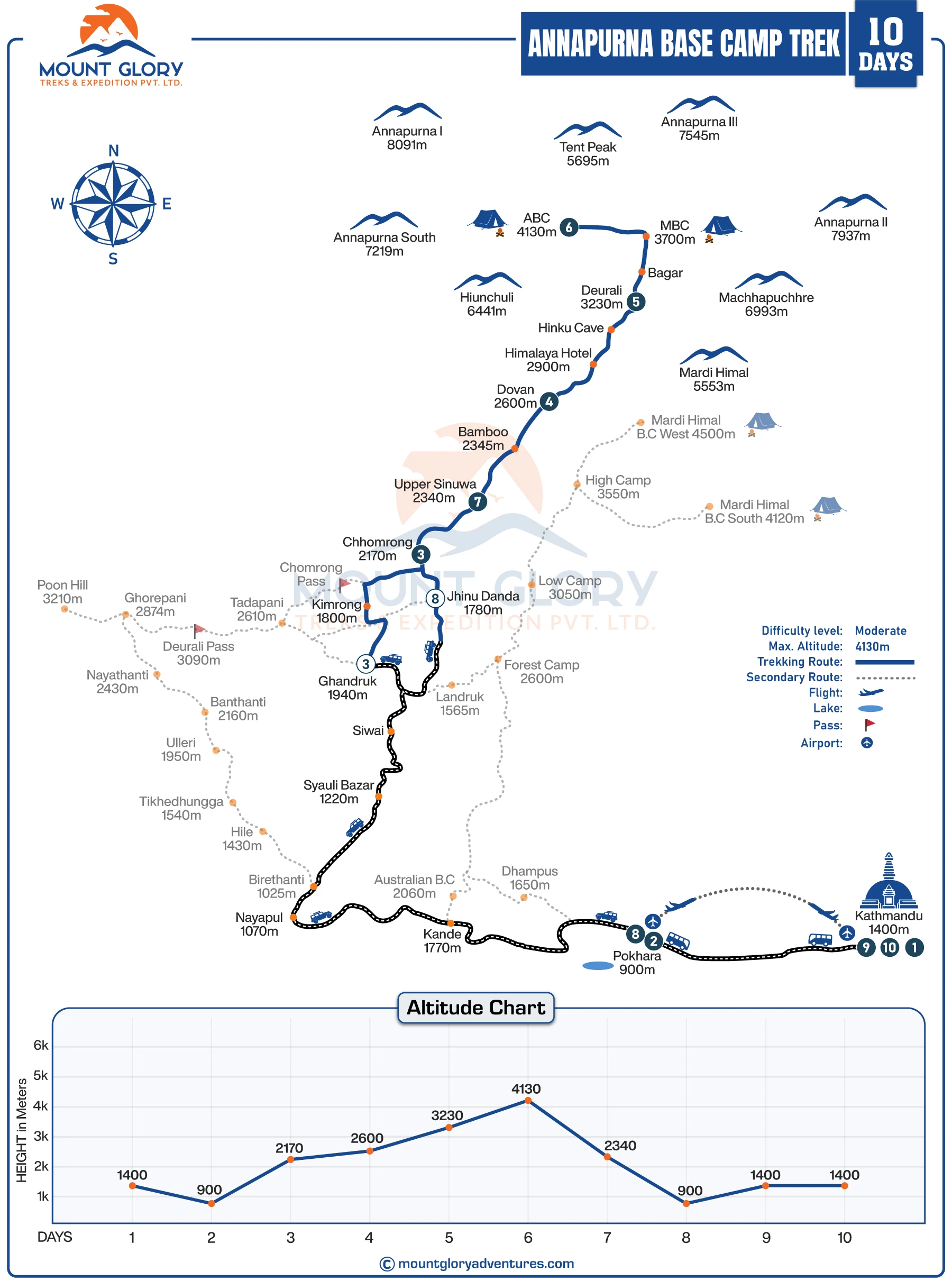
Route Map

Annapurna Base Camp Trek - 10 Days map
What's Included
  • Airport / Hotel / Airport pickup & drop-off by private tourist vehicle.
  •  02-night twin sharing 3-star accommodation in Kathmandu and 3-star hotel in Pokhara; breakfast included. (A single room can be arranged upon payment of an extra price of USD 50 per night).
  • All your standard meals during the trek (breakfast, lunch, and dinner).
  • Standard guest house accommodation while trekking on a twin-sharing basis.
  • Two-way transportation for Kathmandu-Pokhara-Kathmandu by tourist bus.
  • Well, an English-speaking government-licensed holder and experienced trek leader/guide.
  • Porters to carry your bags (1 porter for 2 guests).
  • Food, accommodation, salary, insurance, and equipment are provided for all staff.
  • Free Mount Glory Duffle and T-shirt.
  • Annapurna Conservation Area Permits and TIMS for trekking.
  • All government, hotel, and other applicable taxes.
  • Farewell dinner in a typical Nepali restaurant.
  • Trip Completion Certificate.
  • Official expenses.
What's not Included
  • International airfare and taxes.
  • Personal Travel Insurance.
  • Nepal Entry Visa Fee.
  • Lunch and Dinner in Kathmandu and Pokhara.
  • All items of personal expenses.
  • Tipping for a guide, porters, and drivers (tipping is expected).
  • Any other expense that is not mentioned in the a price includes' section.

Note: Please bring 2 passport-size photos, a copy of your passport, and travel insurance for registration

Add-ons and Options

If trekkers want to take a flight from Kathmandu to Pokhara & Pokhara to Kathmandu instead of a long drive, they can add a flight by plane. Also, additional extra nights in Kathmandu and Pokhara they can add it.

  • Kathmandu to Pokhara Flight Ticket at USD 100
  • Pokhara to Kathmandu Flight Ticket at USD 100
  • Extra night's stay in Kathmandu at USD 50
  • Extra night's stay in Pokhara at USD 40

Dates & Availability

Select a Departure Month
Starts: WednesdayDec 10, 2025
Ends: FridayDec 19, 2025
PriceUS$550
StatusAvailable
Starts: MondayDec 15, 2025
Ends: WednesdayDec 24, 2025
PriceUS$550
StatusAvailable
Starts: SaturdayDec 20, 2025
Ends: MondayDec 29, 2025
PriceUS$550
StatusAvailable
Starts: ThursdayDec 25, 2025
Ends: SaturdayJan 03, 2026
PriceUS$550
StatusAvailable

Useful Information

Packing list for Annapurna Base Camp Hike

One of the most crucial items for any trek is a packing list, which should be organised before preparation. Similarly, we recommend the following packing list for the Annapurna Base Camp Trek:

Clothing

  • Base layers: Warm thermal tops and moisture-wicking t-shirts.
  • Trekking shorts and trousers: Comfortable, lightweight and quick to dry.
  • Fleece or insulated jacket: Provides warmth on cold mornings and evenings.
  • Down jacket: A must for high-altitude evenings near ABC.
  • Waterproof and windproof jacket: Keeps out rain and wind.
  • Trekking socks: Wool or synthetic, multiple pairs.
  • Gloves: Light trekking gloves and insulated gloves for higher altitudes.
  • Hat and beanie: Sun hat for the day, warm beanie for the evening.
  • Gaiters: Optional for snowy or muddy areas.

Footwear

  • Trekking boots: well broken in, waterproof, and supportive of the ankle.
  • Sandals or camp shoes: For unwinding at Jhinu Danda hot springs or in lodges.
  • Extra socks: To keep feet dry and to change every day.
  • Backpack and Gear
  • Daypack (25–35L): For layers, water, snacks, a camera, and everyday necessities.
  • Large or duffel bag: For transportation by porter (if using porter services).
  • Sleeping bag: Suitable for ABC nights at -10°C to -15°C.
  • Trekking poles: Optional but useful on steep and uneven trails.
  • Flashlight/headlamp: With additional batteries.
  • Water bottles/hydration bladder: 2–3 litres capacity.
  • Energy bars and snacks: For quick energy while hiking.

Personal Items

  • Sunscreen: SPF 50+ for protection from the sun at high altitudes.
  • SPF-containing lip balm: To avoid dry lips.
  • Sunglasses: UV-blocking, preferably wraparound.
  • Personal toiletries: toothbrush, toothpaste, biodegradable soap, hand sanitiser, and wet wipes.
  • Towel: Quick-drying travel towel.
  • First aid kit: Include bandages, blister pads, painkillers, altitude sickness tablets, and any personal medications.

Documents and Essentials

  • Passport and ID: Required for permits and accommodation.
  • Permits for trekking: ACAP and TIMS permits.
  • Travel insurance: Helicopter evacuation and high-altitude trekking must be covered.
  • Cash: Nepali Rupees for lodging, small purchases, and snacks.
  • Smartphone and camera: For navigation and taking pictures.

Optional / Extra Items

  • Pen and notebook: For keeping a journal.
  • Book or e-reader: For entertainment during downtime.
  • Portable charger/power bank: Solar chargers are useful in remote locations.
  • Binoculars: Use them to see distant peaks and spot wildlife.
  • Additional lightweight layers: To increase layering flexibility.

Food During the ABC Trek

Your body will require healthy, high-carbohydrate meals when travelling at high altitudes, such as the Annapurna Base Camp, and when engaging in physically demanding activities, such as trekking.

Because of this, our 10-day Annapurna base camp trek itinerary includes three wholesome meals a day (breakfast, lunch, and dinner). Furthermore, during the duration of the package, we will be offering you 9 breakfasts, 6 lunches and 6 dinners.

You can choose from the menu, but keep in mind that due to the remote location, there might not be as many options as you would like. 

Trekkers are also reminded that, in addition to the three meals per day, there are additional costs for other food items such as tea, coffee, cold drinks, and snacks.

Breakfast

  • Eggs (boiled, fried, or omelette)
  • Bread, pancakes, or toast with butter or jam
  • Cereal, oats, or porridge
  • Hot chocolate, coffee, or tea
  • Cookies, biscuits, or energy bars
  • Fresh fruit in season

Lunch

  • Dal Bhat Tarkari (rice, vegetables, lentils, and optional egg or chicken)
  • Pasta, chow mein, or fried rice
  • Momos are fried or steamed dumplings filled with buff, chicken, or vegetables.
  • Noodle soups, also known as thukpa (noodle soup with meat or vegetables)
  • Sandwiches or parathas
  • Snacks such as trail mix, chocolate, and nuts

Dinner

  • Dal Bhat with lentils, vegetables, and optional meat or egg

  • Pasta, chow mein, or vegetable fried rice
  • Momos (fried or steamed)
  • Tomato, chicken, or vegetable soups
  • Yoghurt, pickles, or tiny salads
  • Hot chocolate, coffee, or tea

Eating Advice for the Trek:

  • To stay hydrated, sip bottled or boiled water.
  • For long trekking days, Dal Bhat is a highly recommended source of sustained energy.
  • For quick energy in between meals, pack snacks like chocolates, energy bars, or nuts.
  • At high altitudes, stay away from raw salads to avoid upset stomachs.
  • Vegetarian or vegan diets can be accommodated at most teahouses, but make sure beforehand.

Note: Only breakfast is included during your stays in Kathmandu and Pokhara; lunch and dinner are free to choose for an extra fee.

Accommodation along the Annapurna Base Camp Trek Route

You will travel to the remote and high Himalayan region on this hike to Annapurna Base Camp. In the Annapurna region, this package includes lodging in cosy teahouses and lodges with basic amenities. Rooms for twin and triple sharing are included in the stay.

Additionally, you will have access to a three-star stay in locations like Pokhara and Kathmandu. If you want to upgrade your stays in Kathmandu and Pokhara to more luxurious accommodations, please contact us; we can make it happen for a small additional fee.

Basic amenities like hot showers, Wi-Fi, charging, and hot water are available for additional fees beyond the package price. The remote location of the Annapurna region makes it difficult to find upscale amenities.

Permits required for Annapurna Region Trek

Trekking permits are required when visiting any of the Annapurna region's trekking routes, such as the Annapurna Base Camp Trek.

Two permits are required to enter the Annapurna region. One is the Trekkers' Information Management System (TIMS) permit, which monitors the safety and whereabouts of trekkers in Nepal.

The second is the Annapurna Conservation Area Permit (ACAP), which is required to enter the Annapurna Conservation Area in the ABC region.

  • Trekkers’ Information Management System (TIMS) Permit Cost: NPR 2000 per person.
  • Annapurna Conservation Area Permit (ACAP): NPR 3000 per person.

Note: Travellers don't need to worry about permits because we arrange the necessary permits for your trip and cover all permit fees.

When is the Best time to do the ABC Trekking?

ABC trekking is one of the few Himalayan treks that can be undertaken at any time of year, subject to your experience and preparation. However, autumn (September to November) and spring (March to May) are the ideal seasons for the Annapurna Base Camp Trek.

Autumn season is considered the most ideal time, with clear skies, stable weather and stunning mountain views throughout the trail. The route becomes lively during the spring season, which has moderate temperatures and blooming rhododendrons.

There are benefits and drawbacks to off-season hiking in the winter (December to February) and monsoon (June to August). For travellers who prefer solitude, the winter months are ideal because they are quieter and less crowded. 

However, the chilly nights and sporadic snowfall at higher elevations could be problematic. For this reason, having the right extra equipment for a winter trek will make your experience easier.

Similar to this, monsoon trekking is generally not advised because of the heavy rain, slick paths, and poor visibility, but it is possible if you have the necessary skills.

Note: Since we need to make the necessary arrangements, it is best to get in touch with us before travelling during the off-season.

How do we prepare for a trek to Annapurna Base Camp?

There are numerous things to consider before beginning a ten-day trek in the high-altitude Himalayas, so preparation is essential. Everything, from physical fitness to endurance, gear, and permits, must be double-checked.

Before travelling to ABC, the following steps must be completed:

  • Physical Fitness: Six to eight weeks prior to the trek, increase your endurance by hiking, stair climbing, and cardio exercises.
  • Strength Training: To manage long ascents and carrying a daypack, concentrate on your back, legs, and core muscles.
  • Acclimatisation Knowledge: Acquire knowledge of the signs of altitude sickness and methods for a gradual adjustment.
  • Gear Preparation: Gather suitable trekking boots, warm clothing, a sleeping bag, a daypack, and trekking poles.
  • Packing List: Include a first-aid kit, water bottles, sunscreen, snacks, and personal documents.
  • Mental Preparation: Prepare yourself for long days, shifting weather, and everyday life in a teahouse.
  • Training Hikes: Take a few hikes at a moderate altitude while carrying a heavy backpack.
  • Travel & Permits: Verify travel insurance, TIMS and ACAP permits, and flights or road transportation.
  • Hydration & Nutrition: During training hikes, begin practising energy snacks and hydration techniques.

Major Attractions of the ABC

The Annapurna Base Camp Trek offers a variety of highlights, including the famous ABC sanctuary, breathtaking views of the Himalayas, lively Gurung villages, and steaming hot springs.

Annapurna Base Camp (4,130 m): Highest Point of 10 Days ABC Trek

With a close-up 360-degree view of giants like Annapurna I, Annapurna South, Hiunchuli, Machhapuchhre, and more, this is the trek's highest point.

One of the most amazing sights in the Himalayas is the sunrise view at ABC.

Jhinu Danda: Natural Hot Springs

The natural hot pools at Jhinu Danda, which are close to the Modi Khola, are ideal for unwinding after long trekking days.

It is a well-liked location to relieve tense muscles and take in the tranquil riverbank setting.

Stunning Mountain Views

You are fortunate to have continuous views of Fishtail (Maachhapuchhre), Annapurna South, Hiunchuli, Gangapurna, and Tent Peak along the trek route.

The main highlights of the mountain view, particularly from the ABC, are the golden hour and the sunrise views.

Rich Flora and Fauna

Lush rhododendron forests, bamboo groves, alpine vegetation, and high-altitude landscapes are all part of the route to ABC.

If you're lucky, you might also see a variety of birds, pheasants, langur monkeys, and Himalayan thar.

Gurung Culture & Villages

The Gurung culture and villages are another significant highlight of this ABC trek. In locations like Ghandruk and Chhomrong, you can visit the traditional Gurung communities.

Additionally, discover the way of life, friendly hospitality, stone-paved villages, and culture influenced by Buddhism.

Pokhara – The Lake City

A significant highlight of this trip is Pokhara, the starting point for the ABC trek and well-known for its serene Phewa Lake, exciting nightlife, and adventure activities.

Before and after the hike, Pokhara is a great spot to decompress.

Annapurna Base Camp Elevation

Annapurna Base Camp, located at 4,130 metres (13,549 feet), is surrounded by towering peaks such as Annapurna I, Hiunchuli, and Machhapuchhre.

From low hills to high alpine zones, this trek offers hikers a gradual acclimatisation experience due to its wide range of altitudes. 

Additionally, there are picturesque stops along the way in the mid-altitude villages and forested areas, which are located between 1,900 and 3,000 metres. On the other hand, rocky trails, moraines, and high-altitude meadows can be found in the alpine zones above 3,500 metres.

In order to avoid altitude sickness close to the destination, appropriate pacing, hydration, and rest are crucial for the ABC Trek.

The detailed altitude of the trek portion of the route to ABC is displayed in the table below:

Trek SectionElevation in metresElevation in feet
Kathmandu13244,344
Pokhara8202690
Ghandruk19406365
Chhomrong21707119
Dovan26008530
Deurali323010597
Machhapuchre Base Camp370012139
Annapurna Base Camp413013549
Upper Sinwa/Bamboo2,310 / 2,5007,579 / 8,202
Jhinu Danda17805840

How hard is the Annapurna Base Camp Trek in Nepal?

The standard ABC Trek in Nepal is considered a moderate trek, appropriate for beginners with good basic fitness. Additionally, the trek's highest point is 4,130 metres, making the altitude noticeable but doable at a steady pace.

During this ten-day journey to ABC, you will typically walk for five to seven hours every day, which calls for endurance and perseverance.

Long, steep stone steps can be found along many parts of the trail route, particularly in the vicinity of Chhomrong and Sinuwa. Speaking of weather, it can change rapidly in the Annapurna Sanctuary, making mornings and overcast afternoons more difficult.

The trails are well-maintained and marked, which lowers technical difficulty and facilitates navigation for novice hikers.

The ABC trek is comfortable and achievable with the right planning, a slow pace, and some basic trekking knowledge and experience.

Guide and Porter Service

For the Annapurna Region Trek, a guide is required. Mount Glory Treks provides one experienced guide for a group of eight. If there are more than eight people in your group, we will provide an additional assistant guide to make your trip easier. 

Porters are crucial to your mountain journey because they are in charge of transporting your heavy bags and luggage. Since trekking in Nepal's challenging Annapurna region is nearly impossible without porters, we include them in our package. A porter can carry up to 25 kg of luggage for two climbers.

Note: Our packages include lodging, food, transportation, and travel insurance for the guides and porters.

Altitude Sickness: How to avoid it?

Inadequate adaptation to a high altitude can lead to acute mountain sickness, also known as altitude sickness.

Symptoms of altitude sickness include:

  • Headache
  • Dizziness/light-headedness
  • Nausea or loss of appetite
  • Fatigue or difficulty sleeping
  • Shortness of breath while resting

Trekking at high elevations, like the Annapurna Base Camp (4,130 m) in the Annapurna region, greatly increases the risk of altitude sickness.

For your brief Trek to Annapurna Base Camp, our experienced trekking guides and trip planners have offered the following advice to lower the risk of altitude sickness. 

  • It is advised to hike to higher elevations and sleep at lower elevations.
  • Drink three to four litres of water every day and stay away from alcohol and caffeine to stay hydrated.
  • To strengthen the body and immune system, eat foods high in carbohydrates, such as rice, noodles, and dal bhat.
  • You should always take your time and not rush, even if you feel strong at the start of your journey.
  • To prevent the illness, discuss acetazolamide (Diamox) with your physician.
  • You should not ignore symptoms like headaches, nausea, and dizziness; if they get worse, go downstairs or take a nap.
  • When it's cold outside, stay warm, avoid overdoing it, and get enough sleep.
  • Observe your Guides and seek assistance if you encounter any difficulties.

How safe is the trek to ABC?

Compared to other high-altitude treks in Nepal, the Annapurna Base Camp Trek is thought to be extremely safe. Teahouses at significant stops support the well-established, regularly used route to the ABC.

There are plenty of hikers, guides, and locals on the trail during the busiest times of year, which improves both the overall experience and safety.

The risk of altitude sickness is minimal to manageable due to the trek's moderate altitude and appropriate pace. Additionally, if necessary, emergency helicopter evacuation is accessible throughout the area.

There are no dangerous cliffs or difficult climbing on most of the trail, which is non-technical. Additionally, the locals and owners of teahouses are friendly and used to helping hikers.

Organising your trip with a certified tour guide or a respectable company like Mount Glory Treks significantly improves security and lowers overall risks.

Is travel insurance required for the ABC trek in Nepal?

It is advised that you have the proper travel insurance before beginning your Annapurna Base Camp Trek with us.

Additionally, you should purchase high-altitude travel insurance from a reliable travel company and make sure that it covers trekking risks such as helicopter evacuation, medical coverage, and any kind of emergency at elevations of 4000 m and above.

Travel insurance saves you against risks like altitude sickness, injuries, sudden illness, and trip cancellations, which can be very costly in isolated parts of the Himalayas in Nepal.

Things You Should Know

Before your ABC trek, there are a few other things you should know about the Annapurna region in addition to the trekking route, preparations, and cost.

These items are not part of the package and will add to your ABC Trek budget.

Drinking Water

All teahouses have boiled drinking water, though it may become harder to find at higher elevations. Depending on the location, boiled drinking water typically costs between NPR 100 and NPR 300 per litre.

While bottled water can cost anywhere from NPR 80 to NPR 300 per bottle, you can save money and cut down on plastic waste by using purification tablets or filters.

Hot Showers

For an additional fee, the majority of teahouses along the ABC route offer hot bucket or gas/solar showers. Each shower costs between NPR 200 and NPR 500, and the price goes up as you ascend.

Charging Electronics

Electricity is available in the Annapurna region's high-altitude areas. Depending on the device, charging a phone, camera, or other electronic device will cost you between NPR 200 and NPR 600. Never forget that the cost increases with altitude.

Wi-Fi Availability

The majority of stays at ABC Trek have wifi, which is primarily run by local networks. Additionally, a single wifi login card typically costs between NPR 200 and 500, and in higher regions, the speed may be inconsistent. 

ATM Access

You should be aware that there are currently no ATMs on the trek. Pokhara has the last trustworthy ATMs. A minimum of NPR 15,000 to NPR 25,000 should be carried for meals, showers, charging, and minor expenses while travelling.

Money Exchange

Money exchange services are available in both Kathmandu and Pokhara, but Kathmandu offers the best rates, and Pokhara has a slightly higher spread. Once you enter the trekking area, there are no exchange facilities. Before departing Pokhara, it's advisable to exchange enough Nepali rupees.

Is this Trek perfect for beginners?

The Annapurna Base Camp Trek in Nepal is regarded as a beginner-friendly trek that anyone without any prior experience can undertake.

Beginners may not have many issues because the trails are well-established, the altitude is moderate when compared to other difficult high Himalayan treks, and the teahouse amenities are comfortable.

However, you must ensure that you are reasonably fit and ready for the ABC journey. Beginners should consider the following before travelling:

  • There are lengthy walking days with lots of ascents and stone steps.
  • The trek reaches its highest point at 4,130 metres, so proper pacing and acclimatisation are critical.
  • Pre-trek training or some basic trekking experience makes the trip much simpler.

Where is Annapurna Base Camp, and who discovered it?

The Annapurna Base Camp (ABC) is situated inside the Annapurna Conservation Area (ACA) of Kaski District in the Annapurna region of north central Nepal. 

ABC is located within the Annapurna Sanctuary, a natural amphitheatre of peaks, at an elevation of 4,130 metres (13,550 feet).

Annapurna I, Annapurna South, Hiunchuli, Machhapuchhre (fishtail), and a number of other Himalayan peaks are among the nearby mountains.

During the 20th century, explorers and surveyors first recorded and mapped the Annapurna Himal, particularly during Himalayan reconnaissance missions. Additionally, Annapurna I was the first 8,000-meter peak ever reached when a French expedition led by Maurice Herzog and Louis Lachenal climbed it for the first time in 1950.

Although no one person is credited with finding the ABC, the route and area gained widespread recognition following the 1950 French expedition that explored the Annapurna Sanctuary and recorded its topography.

Since then, one of Nepal's most well-liked trekking routes has emerged from the Annapurna region, particularly the ABC.

How to get a visa for Nepal?

A tourist visa is required for foreign visitors to Nepal who are there for a trek, tour, or other adventure. But compared to other countries, getting your tourist visa is easier in Nepal.

The majority of foreign visitors can obtain a visa at Kathmandu's Tribhuvan International Airport, and you can complete the online application form to expedite the process.

You must fill out the visa application form and have a passport that is valid for at least six months before you can apply for a visa upon arrival.

The costs to get a Nepali visa are as follows:

  • 15‑day visa: US $30
  • 30‑day visa: US $50
  • 90‑day visa: US $125

Tipping Culture

Tipping is an excellent way to thank your guides and porters for their assistance during your Annapurna Base Camp Trek Via Kathmandu, though it is not required. Tipping should typically be at least 10% of the trip's total cost.

If you were extremely pleased with the service, you may tip more than the minimum required for the trip.

Farewell Dinner

We will arrange a farewell dinner for you when you successfully complete your trek to ABC and return to Kathmandu from Pokhara. This will be a unique opportunity to commemorate your accomplishment, talk about your experiences, and take stock of the amazing journey.

You will also have the chance to comment on our services, guides, and general assistance during your journey during the dinner. It's how we thank you for selecting us and make sure your journey ends on a special note.

This farewell dinner also honours your journey, your tenacity, and the relationships you formed along the way.

Trip Completion Certificate

As a reward for your accomplishment, you will receive an official trip completion certificate during our final meeting in Kathmandu prior to the final departure.

The certificate is a significant acknowledgement of your hard work, determination, and accomplishment in reaching one of Nepal's most famous Himalayan destinations.

Additionally, the trip completion certificate can be framed and treasured as a part of your travel achievements, or it can be proudly shared with friends and family.

What is the difference between the Annapurna Base Camp Trek(ABC) and the Annapurna Circuit Trek(ACT)?

While both the ABC Annapurna Base Camp Trek and the ACT Annapurna Circuit Trek are trekking routes in the Annapurna region, they differ greatly from one another.

The shorter, simpler, and more accessible ABC Trek puts you right in the centre of the Annapurna Sanctuary. Whereas ACT is a much longer and more challenging trek that circles the entire Annapurna massif.

ABC provides you with up-close views of Annapurna I, Machhapuchhre, and Hiunchuli. The trek typically takes seven to ten days, and the highest point is 4,130. However, the ACT passes through Thorong La (5,416 m), a high Himalayan pass that is not for everyone.

Additionally, the full Annapurna circuit typically takes 12 to 18 days and covers a variety of landscapes, from arid mustang-like deserts to subtropical valleys.

In conclusion, the Annapurna Circuit Trek is perfect for hikers seeking altitude challenges, cultural diversity, and dramatically changing terrain, while the Annapurna Base Camp Trek is best for novices or hikers seeking a moderate Himalayan experience with lush forests, villages, and mountain panoramas.

Is the Annapurna Base Camp Trekking harder than the Everest Base Camp Trek?

Since ABC and EBC are two of the most well-liked trekking locations in Nepal, tourists frequently ponder which is more difficult.

For the record, the maximum altitude of ABC is 4,130 metres, which is lower than that of EBC, which is 5,364 metres, making it generally easier than the EBC trek and lowering the risk of altitude sickness.

Similarly, ABC has shorter and more comfortable daily distances, whereas the Everest Base Camp trek has longer days with more hours of nonstop walking.

The terrain of the Everest region, which includes rocky oaths, glacial sections, and more rugged mountain terrain, is another factor that makes the EBC more challenging than the ABC. In contrast, the Annapurna region's terrain is simpler, with stone steps and forested trails.

However, because of the higher elevation, acclimatisation is more difficult on the EBC trek, necessitating additional rest days; in contrast, the ABC trek usually requires fewer acclimatisation days. 

In contrast to ABC, which has milder weather, EBC has harsher weather conditions, such as lower temperatures and stronger winds.

In conclusion, EBC is more difficult than ABC overall because it demands greater physical stamina, particularly for hikers who are not accustomed to high-altitude trekking.

How to Book the 10-Day Trek to ABC

Are you excited to finish the 10-day trek to Annapurna Base Camp? Making bookings for this once-in-a-lifetime opportunity is much easier than you might imagine.

Our booking and payment systems are easy to use, secure, and safe for your convenience.
You can book this trip by clicking the Book Now button on our website. We can also be reached directly through WhatsApp, WeChat, or email.

After making your reservation, it is recommended that you email us your flight details, a copy of your passport, and your travel insurance so that we can appropriately arrange your trip.

For every trek or expedition you take part in with us, you must pay 20% of the total cost up front. The remaining amount is due when you arrive prior to the trip.

How to extend your stay in Nepal after the ABC trek?

Once you've finished the Annapurna Base Camp Trek, you'll want to see more of Nepal. After that, you can decide to prolong your trip to Nepal in order to experience its diverse wildlife, rich culture, and breathtaking scenery.

To maximise your time, you can choose from a number of custom packages offered by Mount Glory Treks after the ABC package:

Chitwan National Park – 3 Days / 2 Nights

Discover Chitwan's wildlife safaris, which feature elephants, rhinoceroses, Bengal tigers, and more than 450 bird species. Jeep safaris, canoe rides, nature walks, and visits to traditional Tharu villages are among the activities.

Our team arranges lodging options ranging from eco-lodges to luxury resorts; for more information, see our Chitwan Tour Packages.

Pokhara Sightseeing – 1 Day

You can add a quick stay at Pokhara, which includes a day of sightseeing, after finishing your trek. Discover the world peace pagoda, Devi's Fall, Gupteshwor Cave, and the tranquil Phewa Lake. 

In the laid-back atmosphere of Pokhara, you can also enjoy boating, paragliding, ultralight flying or cafes by the lake. 

Kathmandu Sightseeing Tour – 1 Day

Explore Kathmandu's UNESCO World Heritage Sites, such as Bhaktapur, Patan Durbar Square, Boudhanath Stupa, and Pashupatinath Temple.

Our knowledgeable staff will arrange for comfortable transportation, local guides and admission tickets to ensure you don't miss any of the highlights.

Additional Trekking Options

Additionally, if you are an adventure seeker and want to experience more of the Himalayan journey, you can take advantage of packages such as:

The longer and more difficult Annapurna Circuit Trek circumnavigates the Annapurna Mountains and covers all of the region's highlights. 

Similarly, the Langtang Trek is a stunning walk that circles the Langtang Valley, which is renowned for its picturesque scenery and Tamang culture.

Annapurna Base Camp Trek - 10 Days FAQs

  • Annapurna region is considered one of the safest destinations in Nepal, thanks to its popularity and abundance of hotels in the area.

  • Yes, you’ll find tons of female travelers doing the ABC trek. In fact, you’ll even meet a lot of solo female travelers.

  • To book your ABC trek with Mount Glory, you can use any online platform, credit cards, and bank exchanges. During the trek though, make sure to carry extra Nepali cash.

  • The starting point of Annapurna Base Camp is Ghandruk (2,012 m) and the ending point is Jhinu Danda (1780 m).

  • Mount Glory labels the Annapurna Base Camp trekking’s difficulty as ‘moderate’. While beginners can complete the trek easily, there are still challenges in certain regions. The main one is definitely the final stretch towards the base camp due to steep inclines, icy paths, and thin mountain air.

  • Everest Base Camp is comparatively more difficult than the Annapurna Base Camp. While both regions offer spectacular views of different mountain ranges, Annapurna Base Camp is considered better for beginners.

  • Annapurna means ‘everlasting food’ and the mountain is named after the Hindu goddess of food and nourishment.

  • No, you don’t need a sleeping bag for the ABC trek as there are tea house accommodations all the way up to the base camp. If trekkers need a sleeping bag the team of Mount Glory will provide for trekking use.

  • The main religion practiced in the Annapurna region is Buddhism. But you’ll also find Hindu people and a minority of Islam and Bon Po. The main castes here include Ghale, Gurung, Magar, Thakali, and Tamang.

  • Since every caste has its own language in Nepal, you’ll find different people speaking different languages. Nonetheless, everyone speaks Nepali and very basic English. Only the younger generation is a bit fluent in English.

  • Nepal’s biggest festivals Dahsian and Tihar are celebrated but barely anyone plays Holi due to the cold temperature of the region. Other local-level religious festivals are also celebrated, a popular example is Lhoshar.

  • Yes, many Nepalese are themselves vegetarians, so vegans can do the ABC Trek without having too much headaches. Just make sure you inform the tea houses not to fix any chicken, mutton, or buff items in your food. They’ll understand and prepare you with pure vegetarian food.

  • Trekking gear can be bought and even be rented in Nepal itself. So, you don’t have to hassle carrying everything from your home country. Thamel houses tons of these shops, and Mount Glory ourselves shall help you pick the right equipment for you.

  • If you’re not suffering from major knee pains and can easily hike for 6-7 hours a day, the ABC trek shouldn’t be that difficult for you. So, a basic fitness level is all you need!

  • You can ask for a cancellation before 20-30 days of the trek and you’ll get a 50% cashback. However, if you call for a cancellation at the start of the day, please note that our arrangements for you shall all go in vain, so no cancellation will be accepted.

  • The Annapurna Base Camp trek covers approximately 115 kilometers. The exact distance varies between the nearby attractions you’re going to visit. As mentioned in the article, it should take an overall 10 days, but with customization, this can be reduced to 6-7 days too.

  • If you’re thinking of traveling solo, it’s indeed possible to complete the ABC trek without a guide. You’ll be accompanied by tons of other tourists, so it won’t be hard to navigate your way. Also, the Annapurna Conservation Area is not restricted, so legally you can do it. However, a professional guide by your side is for safety reasons, which Mount Glory highly prioritizes.

  • No, there is no strict age limit. Our guests have taken their children with them who can barely walk. It’s more about the experience that counts when it comes to the Annapurna Base Camp. Even aged individuals can attempt this trek if you have no long-standing disease and prior trekking experience.

  • A 40L to 60L backpack should be good enough when you’re doing the ABC trek. In case you have more personal belongings, our porters are limited to carrying 15 kgs.

  • While there’s no specific amount that you must carry, it’s still a good idea to be backed up with an extra $100 to $200. These can be used to provide tips to the porters or get yourself some snacks if necessary.

  • The temperature in the Annapurna region varies based on the altitude, season, and time of the day. For example, in general, in spring/summer/autumn, the day temperature can range between 13°C to 20°C, while in the evenings, it may drop below 5 degrees. In winter, expect the temperature to not go beyond 10°C during the daytime and below 0 degrees in the evenings.

Clients Reviews

  • rating starWonderful experience

    We just came back from 10 days of trekking to Annapurna base camp. Even though the trekking was tough and the weather was cold, the guide and the porters were very friendly and helpful. And this has made our journey an enjoyable and memorable one.

    K
    Kwee Loon VMalaysia,October 20, 2023
  • rating starI made it to Annapurna base camp!

    We are a group of 6 people, between 48-69 years old. The trip was well-arranged. The tour guide Ami and the porters were helpful and always on the lookout to make sure we were ok. Transport, Food, and accommodation were all well-arranged. Thank you!

    V
    Vacation80001Malaysia,October 20, 2023
SimilarTrips
You may also like